

Nepali alum recognised for strengthening research in climate-resilient infrastructure
Posted: 5 October 2026
Dr Bikash Devkota, an Australia Awards alum from Nepal, is advancing the growing body of research into the effects of climate and environmental change on soils, infrastructure and residential structures in Australia and South Asia.
His latest research article, Shrinkage cracks in expansive soils: Field observations, numerical modelling, and design implications for residential structures, was published in August 2026 in the Journal of Rock Mechanics and Geotechnical Engineering. It was co-authored with his PhD supervisors Md Rajibul Karim, Md Mizanur Rahman and Hoang Bao Khoi Nguyen.
This is one of four articles in the geotechnical field that Dr Devkota has, through his PhD research, published in journals designated Quartile 1 (meaning those that sit in the top 25% of their specific subject category) by the SCImago Journal & Country Rank (a measure of the prestige of academic journals). His research has also explored La Niña cycles, soil moisture and climate change, and geotechnical design.
Dr Devkota completed a Master of Engineering at the University of South Australia in 2021 with the support of an Australia Awards Scholarship, and then pursued a doctoral degree in 2022 with a scholarship offered by Adelaide University.
Drawing on multi-season field observations near Adelaide, laboratory investigations and numerical modelling, his latest research paper examines how shrinkage cracks influence moisture movement through soil. The major finding is that the depth of soil affected by moisture changes can increase from about 3.8 metres in uncracked soil to around 7 metres where significant cracking is present. The findings also highlight the importance of considering soil cracking and subsurface moisture pathways in geotechnical assessment and foundation design.
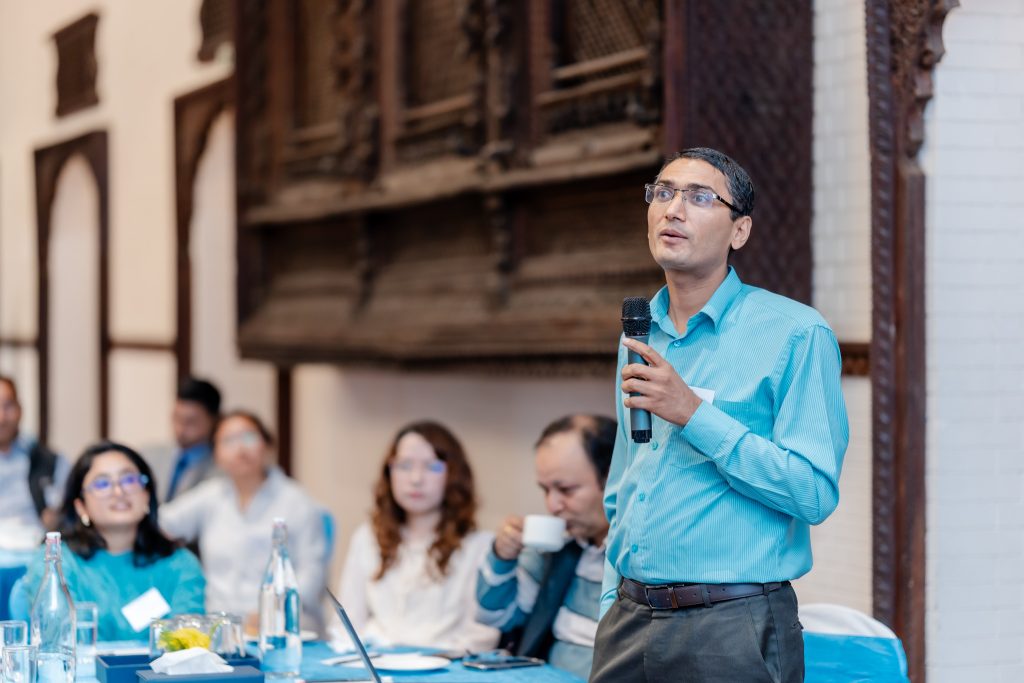
Dr Devkota attending an Australia Awards – Nepal learn & network alumni event.
The study examines expansive soils, which swell when wet and shrink when dry, potentially causing ground movement that can affect houses, roads, pipelines and other infrastructure. Nearly 30% of Australia’s surface soils are classified as expansive, making their behaviour an important consideration for infrastructure resilience.
Although the research is based on Australian conditions, its findings have broader relevance and could help other countries in the region, like Nepal, improve the resilience of infrastructure against the effects of climate change.
“The research is particularly relevant to climate-resilient infrastructure because changes in rainfall and temperature patterns may intensify drying–wetting cycles and consequently affect expansive-soil behaviour, including shrinkage crack formation and propagation,” Dr Devkota says.
The publication has also attracted significant media attention in Australia. Following coverage on the Adelaide University website, the research was picked up by many media outlets, including Techxplore, Azobuild and National Radio News.
After completing his PhD in Australia, Dr Devkota returned to Nepal earlier this year and is now working as a Senior Divisional Engineer in the Government of Nepal’s Ministry of Energy, Water Resources and Irrigation. He plans to continue collaborating with academia, government, industry and professional societies to advance research and contribute to resilient geotechnical solutions for climate-affected environments.
Dr Devkota’s journey highlights the enduring impact of Australia Awards, demonstrating how alumni apply and share their expertise through contributions to world-class academic research and publications. His work also reflects Australia’s investment in developing skilled leaders whose knowledge and research contribute to addressing shared development and climate resilience challenges across the Indo-Pacific region.