

Alumna amplifying marginalised voices in Nepal from policy to parliament
Posted: 11 November 2026
This year marks the 75th anniversary of Australian Government scholarships for students from the Asia-Pacific region, with the first scholarship recipients travelling to Australia under the Colombo Plan in 1951. To commemorate this significant milestone, Australia Awards – South Asia & Mongolia launched the Alumni Impact Storytelling Competition to celebrate the outstanding contributions alumni have made to the development of their countries.
The competition invited alumni to showcase the impact they have created and reflect on how their Australia Awards experience has helped shape their personal and professional journeys.
Nepali alumna Dr Sujata Tamang’s entry (below) placed in the ‘Commended’ category of the competition for its powerful account of a journey from a remote Indigenous farming community to national leadership. Dr Tamang completed a Master of Indigenous Studies at the University of New South Wales in 2012 with the support of an Australia Awards Scholarship. Her story highlighted how educational opportunities, including her Scholarship and a John Allwright Fellowship, helped deepen her expertise in Indigenous rights, social justice and inclusive agri-food systems. Judges were particularly impressed by her commitment to advancing the rights of smallholder farmers, women and marginalised Indigenous communities.
As the sixth of seven children born to my parents in Tamang, a low–middle income farming-dependent Indigenous community in a rural mountain village settled between forests and rivers, I witnessed a life shaped by the rhythm of the seasons, the land, the forest, the river and hardship. My siblings and I are the first generation of our family to obtain university degrees; our mother is illiterate, and our father possessed only basic literacy without ever completing first grade.
Our wealth consisted entirely of our annual crop harvest and livestock—chickens, pigs, cows and goats. As members of one of the Indigenous ethnic minorities of Nepal, pigs, cows and homemade alcohol served as the primary sources of income for our family. My parents’ days began long before sunrise: fetching water, taking care of livestock, hauling fodder and firewood, and performing seasonal farm work. My siblings and I assisted with these chores, fitting in limited study time whenever possible. Whether cultivating the land, collecting fodder and forestry residues (for animal beddings), or grazing cattle in the forest during school holidays, I learnt early on that the forest is an integral part of farming and that there is a profound connection between life, land and environment.
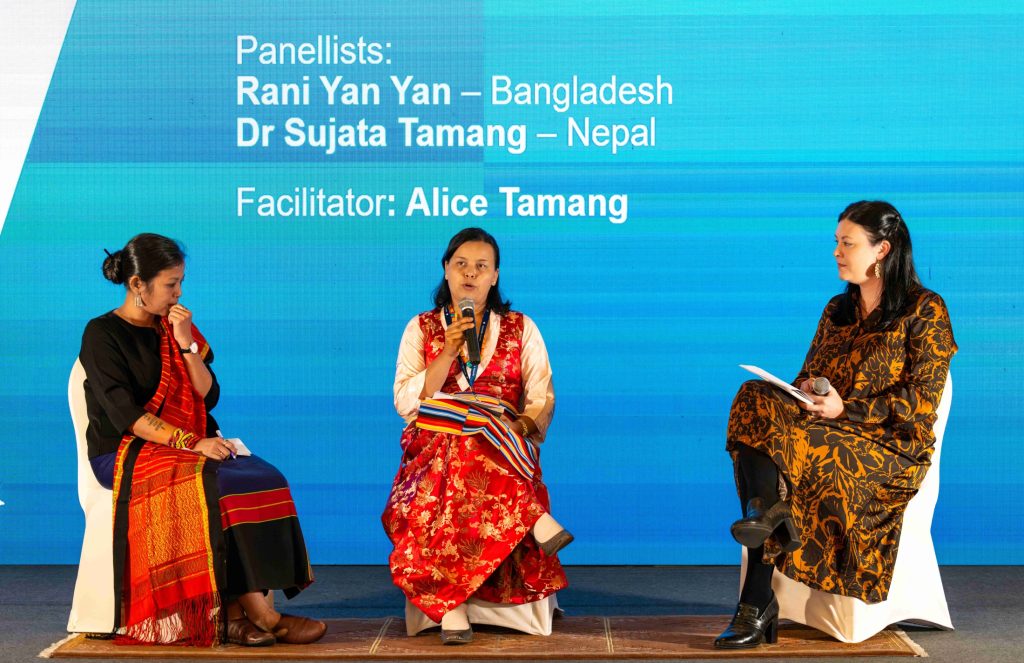
Sujata (middle) participates in a panel discussion on gender equality at the 2024 Regional Alumni Workshop in Thimphu, Bhutan, alongside Alice Tamang (right), Indigenous Engagement Adviser with Australia Awards South Asia & Mongolia, and alumna Rani Yan Yan (left) from Bangladesh.
At the time, most children in our village attended local government schools. I remember the fascination of seeing a new private school (up to grade three) where students wore ties and shoes; such things were beyond our family’s means. Our village had no roads, no internet and no mobile phones—only a few landlines at the village centre near the domestic airport, which provided the only connection to major cities like Kathmandu and Biratnagar.
After I completed grade seven, one of my elder brothers moved me to different parts of Nepal to ease our parents’ burden and to give me better educational opportunities as he travelled for his newly started professional career. I finished my bachelor’s degree while living with his family, then moved alone to Kathmandu, the capital city, to pursue a master’s degree in Rural Development.
I began my professional career as a front desk staffer at ForestAction Nepal, a non-profit organisation working mainly in the areas of forestry, biodiversity, agriculture and food systems, and sustainable livelihoods. From the front desk, I transitioned into policy research, focusing on natural resource management and inclusive development. My research in exploring policy gaps and studying local lives and livelihoods—including gender and social inclusion issues, capacity building of smallholders, and engagement in district and province-level agriculture plan formulation, particularly in the Karnali region (the least developed and most structurally disadvantaged province in Nepal)—helped me to understand how policies shape the lives and livelihoods of those who rely on natural resources for survival.
That experience opened doors to wider exposure and opportunities, including scholarships for both academic and professional training. In 2012, I received a prestigious Australia Awards Scholarship to study a Master of Indigenous Studies at the University of New South Wales (UNSW), Sydney. Stepping into an international academic space was far beyond my childhood imagination. It deepened my understanding of social policies, global Indigenous struggles and social justice. Most of the marginalised Indigenous people of Nepal also have similar painful histories, experiences and struggles.
Upon returning to Nepal, I rejoined ForestAction Nepal and worked on an action research project supported by the Australian Centre for International Agriculture Research (ACIAR) that aimed at enhancing livelihoods and food security. Additionally, I kept engaged in the issues related to sustainable agri-food systems where structural social injustice and inequalities prevail. Generating evidence and feeding it into policy formulation through advocacy and dialogue with a wide range of stakeholders, including policy makers, allowed me to closely witness how policies are developed.
In 2015, the John Allwright Fellowship took me back to UNSW for my PhD study in Social Sciences. This four-year journey further enhanced my expertise in research, policy analysis, and social and ecological justice.
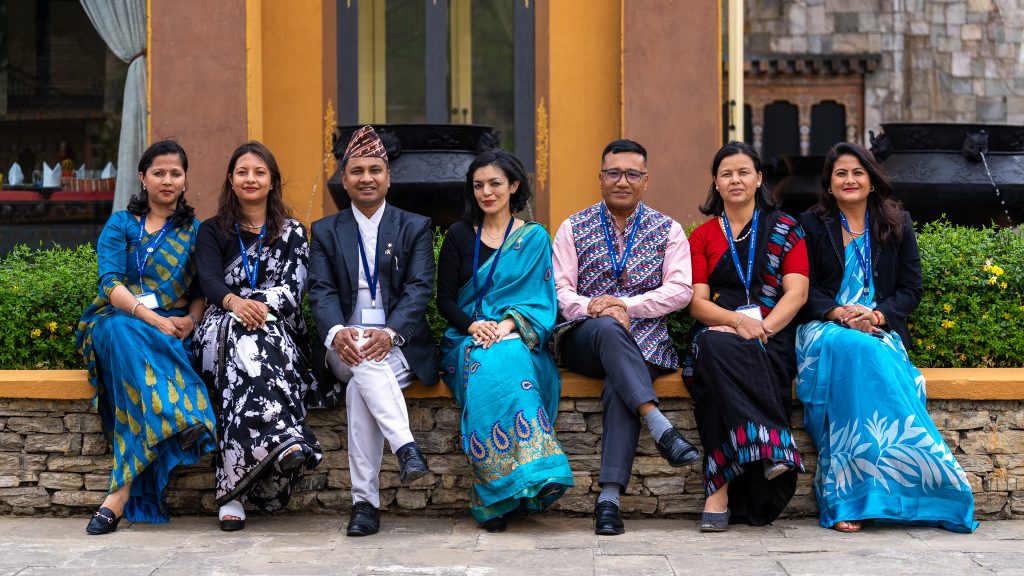
Sujata (second from right) is pictured with fellow Nepali alumni and Australia Awards – Nepal staff members at the 2024 Regional Alumni Workshop in Thimphu, Bhutan.
Returning to Nepal in 2019, I continued my work in policy research and advocacy through ForestAction Nepal and the Alliance of Agriculture for Food, a collective campaign involving farmers, civil society groups, and national and international non-governmental organisations working on the issues of food, land, agriculture and climate change. Guided by commitment to building an inclusive and transformative agri-food system in Nepal, I focused on championing the rights of smallholders, women and marginalised Indigenous communities, helping them amplify their voices and strengthen their capacity to fight for food security and sovereignty. My research and policy advocacy were focused primarily on agroecology, resilient and inclusive agri-food systems, Indigenous knowledge, social and ecological justice, and smallholder farmers, including women, Indigenous communities, landless people and other marginalised groups. Alongside organisational roles, I also contributed, as an expert member, to Nepal’s National Roadmap of Agroecology, which was submitted to the Government of Nepal in 2025.
My role within ForestAction Nepal grew steadily from 2008 to 2026. I eventually served as Executive Coordinator for a short time. In early 2026, my career took a significant turn when I was elected as a Member of the House of Representatives of Nepal under the proportional representation system. Nominated under the Indigenous Women quota based solely on my expertise on gender, Indigenous affairs, agriculture and social policy (I was not affiliated with any political party), I will now serve as a member of the Parliamentary Committee on Agriculture, Cooperatives and Natural Resources Management.
My story is not mine alone; it is a testament to the collective efforts of my family and community, the guidance of my mentors, and the vital role of educational opportunities like Australia Awards. From a farming family in a remote village to the halls of Parliament, my core commitment remains unchanged: to serve as voice for the voiceless and to champion the dignity, rights and sovereignty of smallholder farmers, women and marginalised Indigenous communities. I firmly believe there can be no social justice without ecological justice, and that we must continue breaking the barriers faced by those who have been historically marginalised and oppressed.