

Alumni learn about mitigating pollution in Nepal
Posted: 13 June 2025
On Friday 6 June, Australia Awards alumni from Nepal came together to mark World Environment Day in Kathmandu. The event was facilitated by Australia Awards alumni Amita Thapa Magar and Dr Bimal Raj Regmi. More than 70 Australia Awards alumni participated in the event.
Welcoming the alumni, Luna Purification, Head of Development at the Australian Embassy in Nepal, shed light on the common environmental challenges facing Nepal and Australia. Both countries are exposed to climate change impacts, pollution, rising temperatures and extreme weather events. “These common problems and shared experiences bring Australia and Nepal closer to preserving our environment through mutual support and partnership,” she said.
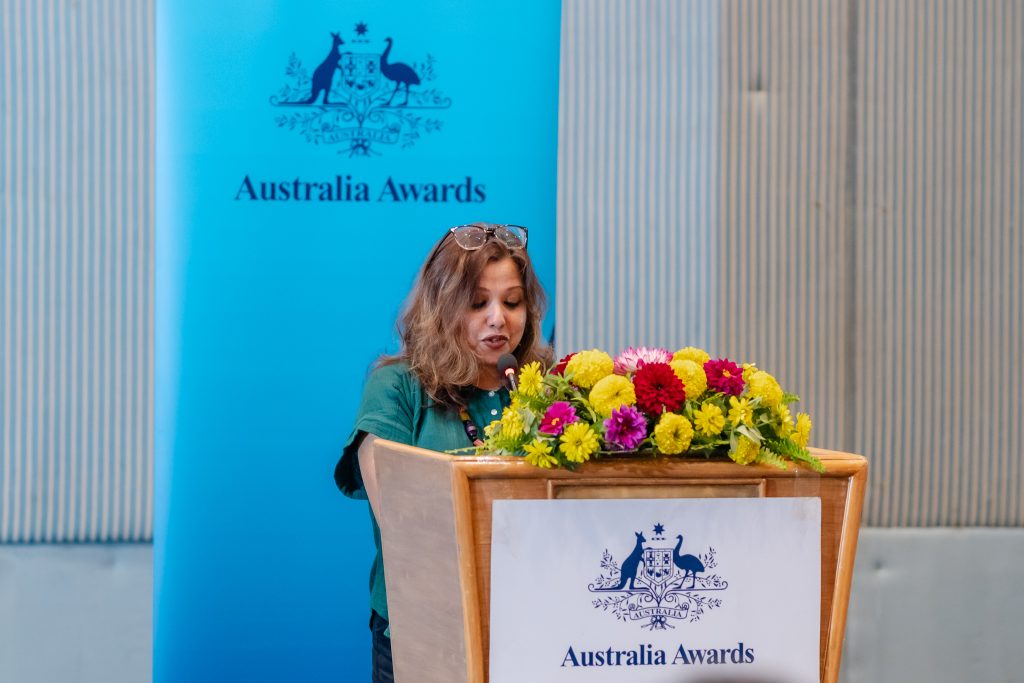
The Australian Embassy in Nepal’s Head of Development Luna Purification welcomes alumni to the event.
Bhushan Tuladhar, an eminent Nepali environmental engineer and sustainability activist, delivered the keynote address at the event. His speech focused on ‘Finding lasting solutions to pollution control in the major cities of Nepal’.
Bhushan painted a grim picture of pollution in major cities worldwide, including Kathmandu, triggered by two major human-induced factors: rapid urbanisation and the impacts of climate change. The air quality in Kathmandu has increasingly deteriorated due to excessive carbon dioxide emissions from brick factories, substandard vehicles and wildfires in the neighbouring areas. Air quality is measured against PM2.5—particulate matter with a diameter of 2.5 micrometres or less. According to IQ Air, the annual average concentration of PM2.5 in Kathmandu is 8–10 times higher than the maximum level recommended by the World Health Organization. This has caused severe health problems and even death. Bhushan shared that in 2024 alone, 5,084 deaths just in Kathmandu and 48,500 deaths in the whole of Nepal were attributed to air pollution, according to the Health Effects Institute.
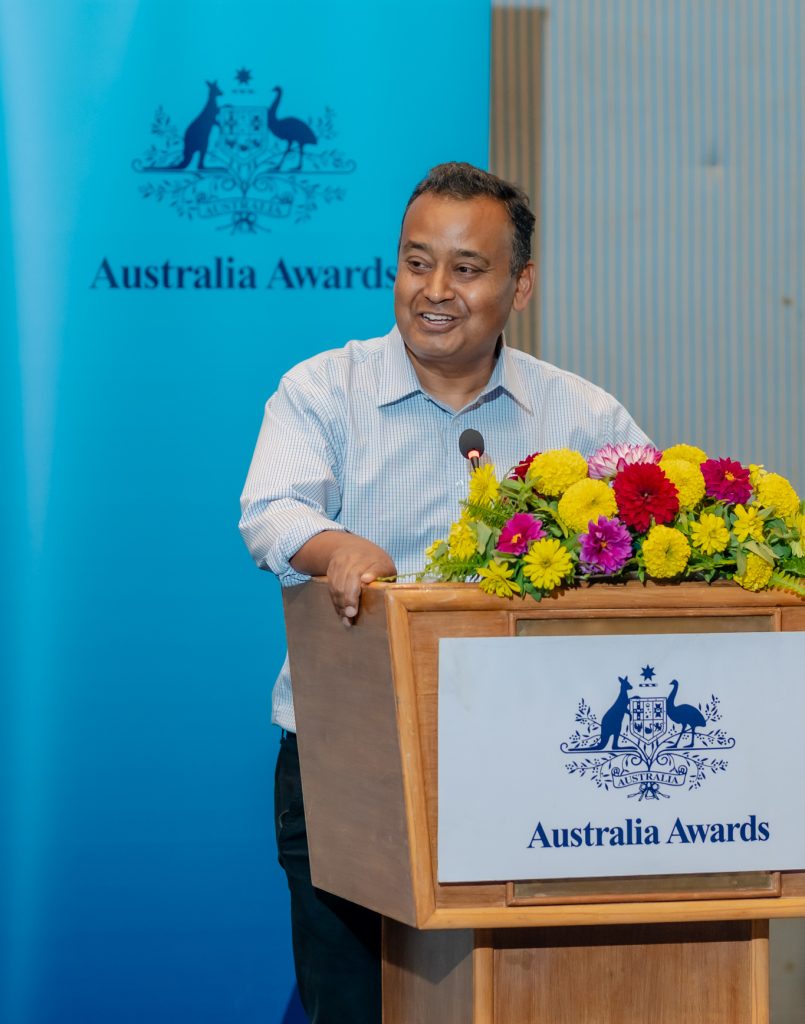
Renowned environmental engineer and sustainability activist Bhushan Tuladhar delivers a keynote speech on pollution control solutions in Nepal.
To overcome this challenge, Bhushan emphasised the ‘three R’s’—reduce emissions, reduce exposure and raise voices. As straightforward mitigations to household pollution, he recommended transitioning to using clean fuel, efficient stoves and adequate ventilation. Similarly, as solutions to ambient air pollution, he advised embracing clean transport (such as walking, cycling, taking public transport and using electric vehicles), encouraging cleaner production in industries through solid waste management, and adopting better management of forest fires and open-burning of agricultural residue. However, he noted that these recommendations require intensive engagement with local governments, civil society and the private sector. Bhushan concluded, “Local leadership, stakeholder partnership and community ownership are essential for effective air quality management.”
Following the keynote speech, Shilshila Acharya, environmentalist and social entrepreneur, spoke about her experience of solid waste management in Nepal’s local context. Shilshila, who chose to pursue environment studies over a fully-funded medical studies program because of her passion to contribute to this field, shared her story of successful campaigns to reduce plastic pollution through social entrepreneurship. Her journey began with the Hamri Bahini (“Our little sisters”) initiative, which created green jobs for more than 1,300 women working in the household sector. Next, she initiated a project to replace plastic bags with reusable shopping bags. Over three months, the initiative sold 70,000 bags and replaced 10 million plastic bags. However, as she mentions, this was the equivalent of only two days of plastic use in Kathmandu. Consequently, she went on to campaign for a ban on single-use plastic products. Her relentless efforts resulted in the Government of Nepal banning single-use plastic in April 2015.

Social entrepreneur Shilshila Acharya shares her journey in plastic pollution reduction and recycling.
In 2019, Shilshila and her team founded a social enterprise called Avni Ventures. Avni is one of the largest plastic collecting and recycling networks in Nepal. Through Avni, Shilshila is managing and recycling plastic waste in 57 municipalities. She aims to expand these networks to all 753 municipalities of Nepal in the near future. She has also been part of the ‘Mountain Clean-up’ campaign. In collaboration with the Nepali Army, the campaign has removed 119 tons of waste from mountains, including Mount Everest, since 2019. In recognition of her contributions, several organisations have given Shilshila prestigious awards. The BBC listed her on its 100 Women list for 2024, which names 100 inspiring and influential women from around the world. However, for Shilshila, action is more important than any award. “If we focus on our work, recognition will follow on its own,” she says. Shilshila is working towards creating 100,000 climate leaders in the next five years, as she knows that combatting pollution requires well-informed leadership.
World Environment Day is marked yearly on 5 June to increase awareness and action for environmental protection. This year’s theme focused on combatting plastic pollution.