

Alumni lecture highlights urgent need for disaster preparedness in Nepal
Posted: 16 June 2026
On 29 May 2026, Australia Awards – Nepal, in collaboration with the Association of Nepalese Alumni from Australia (ANAA), organised a public lecture for alumni in Kathmandu on the theme of ‘Building a disaster-resilient Nepal: Why preparedness matters’.
The key speaker was Professor Bishal Nath Upreti, an Australia Awards alum and one of Nepal’s leading geologists. Professor Upreti attended a course on Pandemic Preparedness and Health Disaster Management at Queensland University of Technology in 2008, with the support of an Australia Awards Fellowship.
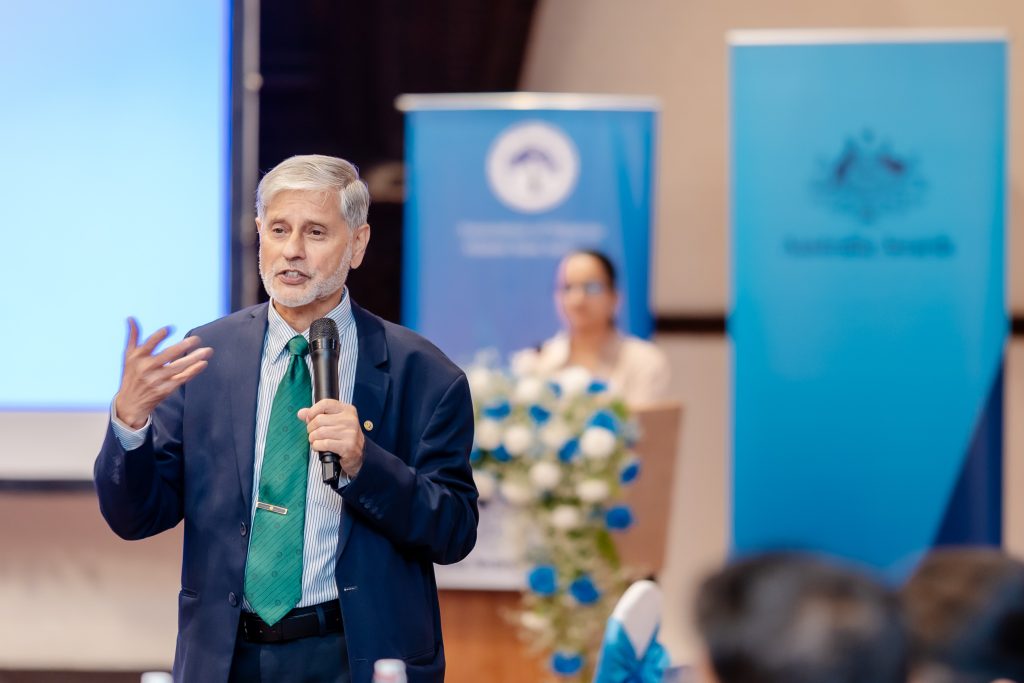
Professor Bishal Nath Upreti, an Australia Awards alum and one of Nepal’s leading geologists, delivering the lecture.
The lecture aimed to raise awareness of the critical importance of disaster preparedness, drawing on lessons from the devastating 7.8-magnitude Gorkha earthquake that took place on 25 April 2015, along with other seismic events that Nepal has experienced over the past decade.
Opening the event, Dylan Jones-Virma, Head of Development at the Australian Embassy in Nepal, welcomed the alumni and emphasised the relevance of the topic. “Events like this not only provide scholarly knowledge, expert insights and practical solutions to pressing challenges, but also showcase the depth of expertise within our alumni community in Nepal,” he said.
Dylan also highlighted the shared disaster-related challenges faced by Nepal and Australia. “Both countries are prone to floods, bushfires and other natural hazards,” he said. “We therefore have much to learn from each other’s experiences.”
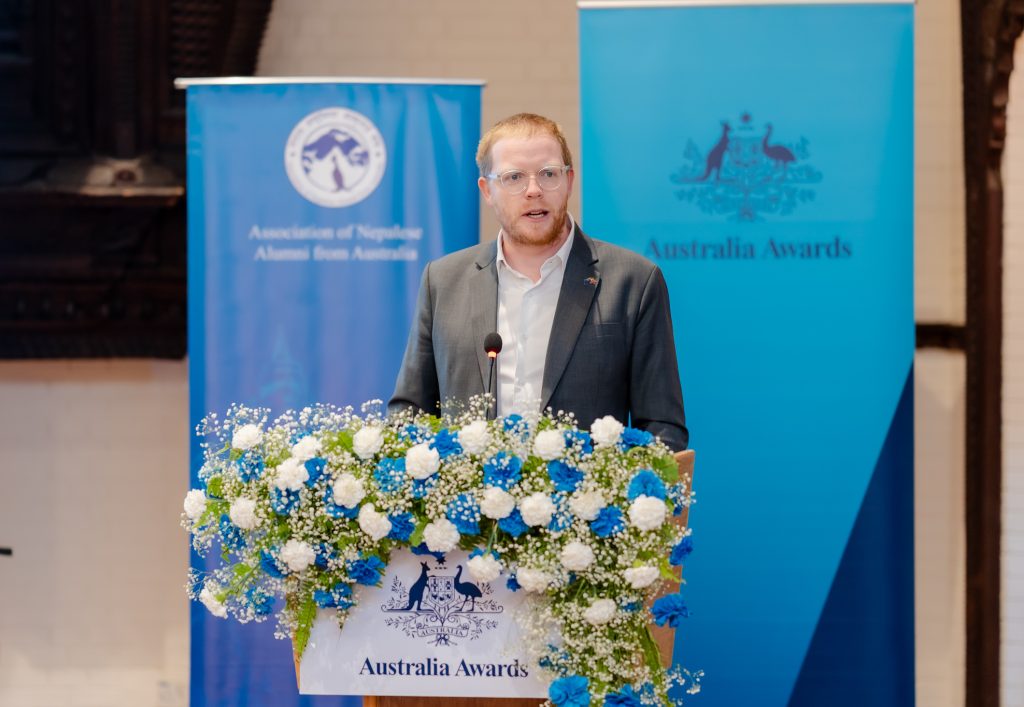
Dylan Jones-Virma, Head of Development at the Australian Embassy in Nepal, addressing the attendees.
In his lecture, Professor Upreti described Nepal as one of the world’s most disaster-prone countries. He warned that the country faces an inevitable and potentially devastating earthquake in the future, urging immediate and sustained efforts to strengthen preparedness and resilience. The United Nations Office for Disaster Risk Reduction’s most recent Disaster Risk Reduction in Nepal status report (2019) notes that the country ranks 11th in terms of global risk for earthquake occurrence and impact, and is among the top 20 countries globally for multi-hazard risk.
Professor Upreti discussed Nepal’s history of seismic events, with the first documented earthquake event occurring in 1255. Since then, Nepal has experienced at least one major earthquake per century. In addition to the 1255 earthquake, which killed one-third of Kathmandu’s population at the time, major earthquakes in 1833, 1934 and 2015 resulted in widespread destruction and significant loss of life. The 1934 earthquake alone claimed more than 8,500 lives, while the 2015 Gorkha earthquake killed nearly 9,000 people and injured approximately 25,000, leaving lasting economic and psychological impacts.
He stressed that such disasters are not isolated events. Geological records indicate that the Himalayan region experiences ‘great earthquakes’ (magnitude 8 or higher) every few hundred years, and Nepal has not experienced such a significant event since 1934.
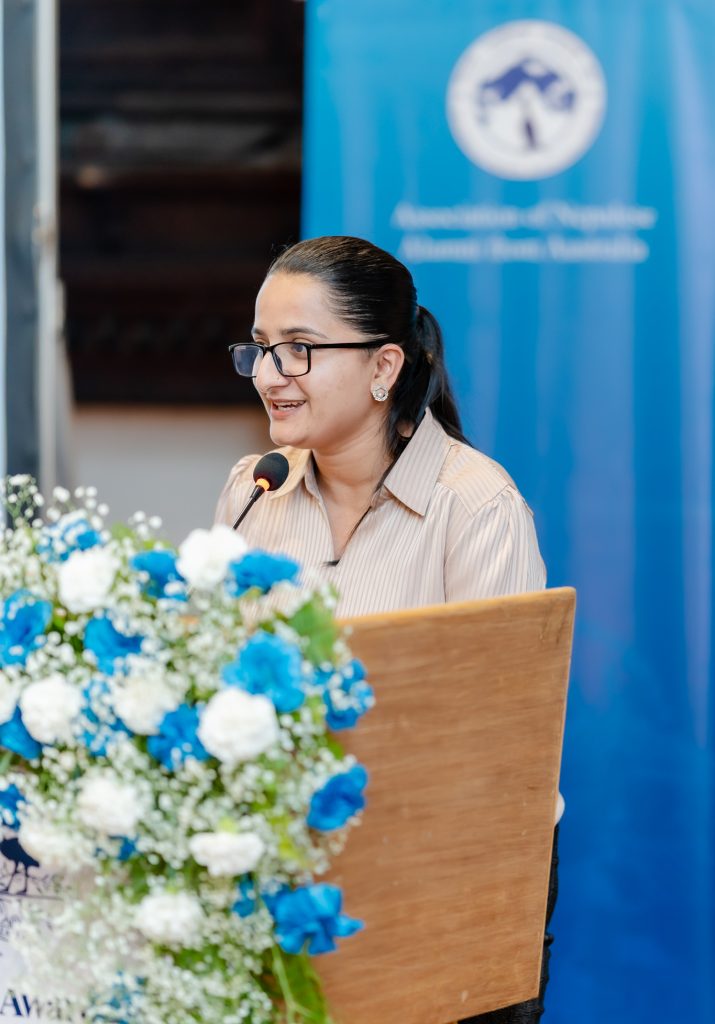
Alum and ANAA Executive Member Manisha Burlakoti facilitating the event.
Providing a geological perspective, Professor Upreti explained that Nepal lies along an active collision zone where the Indian continental plate continues to move northwards beneath the Eurasian plate. This process shortens the Earth’s crust by more than two centimetres each year, building immense tectonic stress. The stress accumulates along the Main Himalayan Thrust—a fault system that remains largely ‘locked’—and is eventually released in the form of powerful earthquakes.
Importantly, he noted that the 2015 earthquake did not release all the accumulated energy. Scientific analyses suggest that significant stress remains beneath the Himalayas, meaning a larger earthquake is still likely. “We were not expecting the 2015 event—it came earlier than anticipated,” he said, adding that scientists have long warned of an even bigger earthquake yet to come.
Researchers have also identified ‘seismic gaps’: areas, particularly in western and eastern Nepal, where no major earthquakes have occurred for centuries. These regions are considered highly critical and capable of generating earthquakes exceeding magnitude 8.

Alum Krishna Raj Bajgain shares his reflections.
Professor Upreti emphasised the sudden and destructive nature of earthquakes. “It happens in seconds, but rebuilding takes years, and the scars remain for a lifetime,” he said. He warned that a future major earthquake could result in tens or even hundreds of thousands of casualties, especially due to weak and poorly constructed buildings. Even moderate earthquakes (magnitude 6–7) can cause serious damage and fatalities in the absence of resilient infrastructure.
Reflecting on the 2015 earthquake, he acknowledged that prior awareness campaigns and training had contributed to relatively effective rescue and relief efforts. However, he cautioned that preparedness must be continuously strengthened rather than treated as a one-time effort.
Having established the risks, Professor Upreti outlined several key measures to reduce potential losses. At the national level, he called for the urgent establishment of an ‘earthquake early warning system’, noting that even 10–30 seconds of advance warning can save lives. He also stressed the importance of strengthening disaster management institutions, enhancing emergency response training, and increasing public awareness through education and community engagement.

Alum Sudip Ale shares his views.
At the household level, he emphasised that safe construction is the most critical factor. “A strong house saves lives,” he said. Retrofitting older buildings and ensuring earthquake-resistant designs in new construction are essential steps. Simple preparedness measures—such as securing furniture, preparing emergency kits, and practising safety actions like ‘drop, cover and hold’—can further reduce casualties.
Concluding his lecture, Professor Upreti delivered a strong message: Nepal cannot prevent earthquakes, but it can prepare for them. “The question is not whether an earthquake will occur,” he said. “It is when—and how prepared we are when it does.”
Following the lecture, event facilitator Manisha Burlakoti (an Australia Awards alum and ANAA Executive Member) invited participants to share their reflections. Alumni described the lecture as highly insightful and emphasised that preparedness is essential.
ANAA President Ananta Poudyal closed the event with a message of thanks to the speakers and attendees. In his remarks, he emphasised that there is no alternative to preparedness in reducing future earthquake risks and encouraged alumni to play an active role in ensuring the safety of their families and communities.
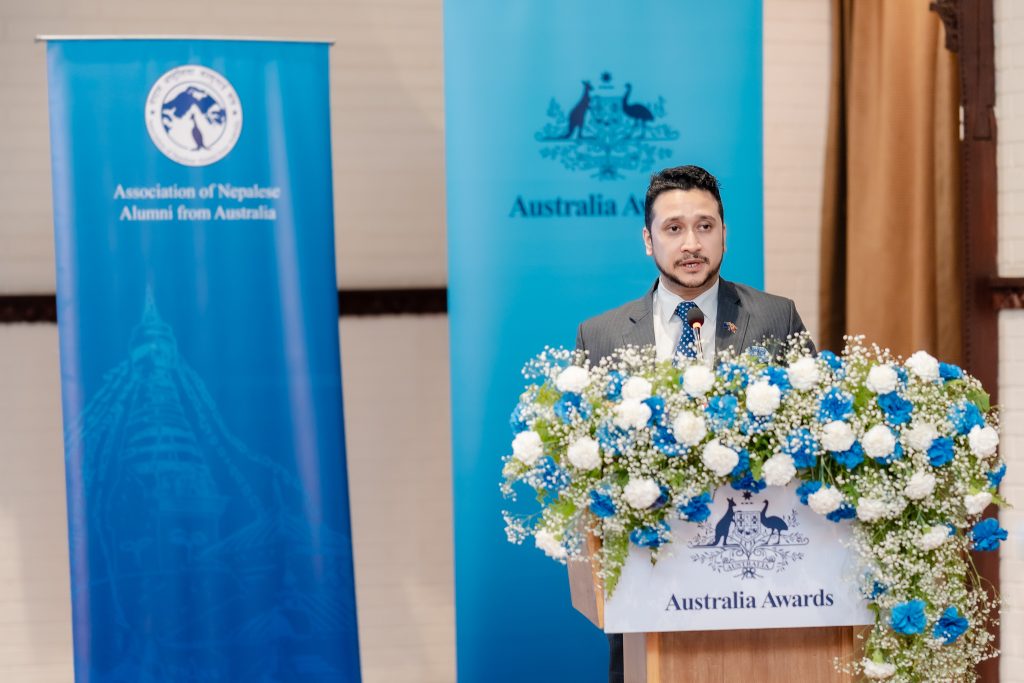
ANAA President Ananta Poudyal delivering his remarks.
Since 2017, Australia Awards – Nepal has hosted a series of public lectures that bring together distinguished Nepali and Australian thought leaders to inspire learning and dialogue within the alumni community. Previous lectures have featured renowned figures such as pioneering eye surgeon Dr Sanduk Ruit, eminent Australian public health expert Professor Rob Moodie, and Nepal’s first female Chief Justice and former Prime Minister Sushila Karki. The series continues to empower alumni with knowledge and insights, encouraging them to take on leadership roles in addressing Nepal’s most pressing development challenges.