

Alum’s research on climate change adaptation published in international journal
Posted: 10 December 2025
Australia Awards alum Melsan Shrestha has achieved a significant milestone with his research on climate change adaptation practices being published in The Journal of Environment & Development, a respected international peer-reviewed journal.
Melsan is currently Thematic Lead – Resilient Livelihoods at the United Mission to Nepal, and is one of four Nepalis who participated in the Australia Awards – South Asia & Mongolia Regional Short Course on Integrating Climate Change Adaptation and Disaster Risk Reduction to Reduce Vulnerability from March to August 2023. The Short Course was delivered in Brisbane and online by Griffith University.
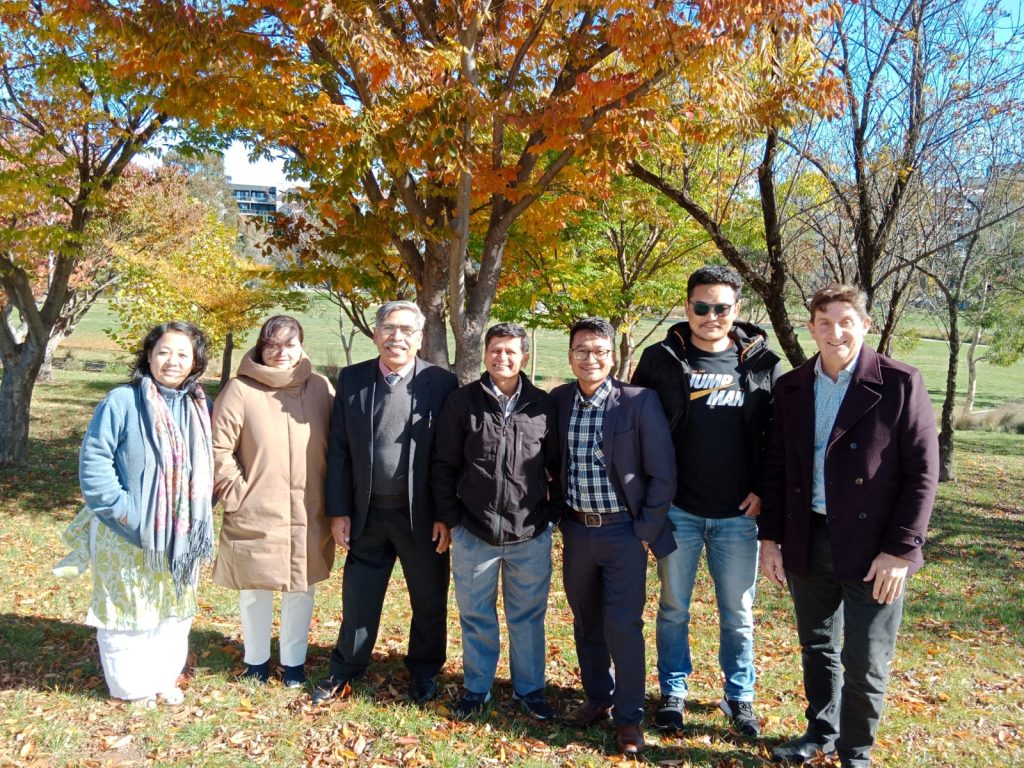
Melsan (third from right) with other Australia Awards Short Course participants and Dr Robert Hales from Griffith University (right) during an educational field visit.
The course deepened Melsan’s understanding of the links between climate change adaptation and disaster risk reduction; evidence-based planning; gender equality, disability and social inclusion (GEDSI) sensitive assessments; and community resilience approaches.
“My participation in the Short Course profoundly strengthened both the conceptual and practical dimensions of my work in Nepal,” says Melsan.
As part of his Return-to-Work Plan following the Short Course, Melsan collaborated with Dr Robert Hales from Griffith Business School to produce the recently published research article, which is titled ‘Comprehensive Capitals Approach to Climate Change Adaptation Practices: The Case of Kapilvastu District of Nepal’.

Melsan (right), Dr Robert Hales (left) and fellow Nepali participant Nilkantha Pandey (centre), photographed during their educational visit to Australia’s Parliament House in Canberra.
Melsan’s Return-to-Work Plan focused on improving the livelihoods of vulnerable farming households through climate change adaptive farming practices in Yashodhara, a Rural Municipality in Nepal’s Kapilvastu District. Melsan aimed to document local climate adaptation practices and analyse the socioeconomic, institutional and environmental factors shaping their adoption.
Melsan notes that Nepal is highly vulnerable to climate change, with farming households that endure multiple forms of marginalisation experiencing the greatest impact. While many farmers already practice adaptive strategies, he says that evidence of their effectiveness and adoption-drivers remains limited. Melsan’s Return-to-Work Plan addressed this gap, generating evidence to support inclusive and sustainable climate adaptation programming.
The study documents local adaptation practices and analyses socioeconomic, institutional and environmental factors influencing adoption. It involved a survey of 526 farming households, complemented by focus group discussions and community consultations. Findings revealed that 76% of households adopted at least one adaptation practice, with adoption driven by factors such as farmer group membership, extension support, input availability, local knowledge, household characteristics and perceived climate risks.
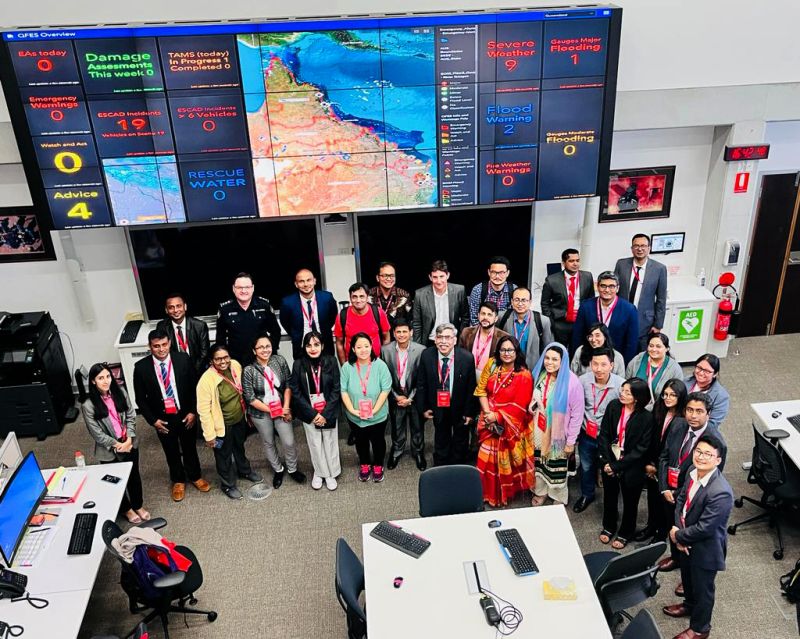
Melsan (front row, right) with participants of the Australia Awards Short Course during a study visit to the State Disaster Coordination Centre at Kedron, Brisbane, focusing on decision-support tools for disaster planning and response.
“Stakeholder engagement was central to the Return-to-Work Plan,” Melsan says. “Farmers, women, people with disability, Dalit communities, local government, community-based organisations, the United Mission to Nepal and Griffith University mentors ensured that the research remained grounded, inclusive and reflective of community realities.”
In addition to publication of the peer-reviewed article, key outcomes of Melsan’s Return-to-Work Plan have included documentation of 12 locally relevant climate adaptation practices and identification of factors influencing adoption.
The Short Course provided Melsan with hands-on tools for vulnerability assessments, resilience measurement and participatory research methods. The mentorship from Griffith University experts helped refine his methodology and supported the publication process. Discussing his mentors, Melsan says, “Their guidance continued beyond the course, supporting the preparation and publication of the article.”
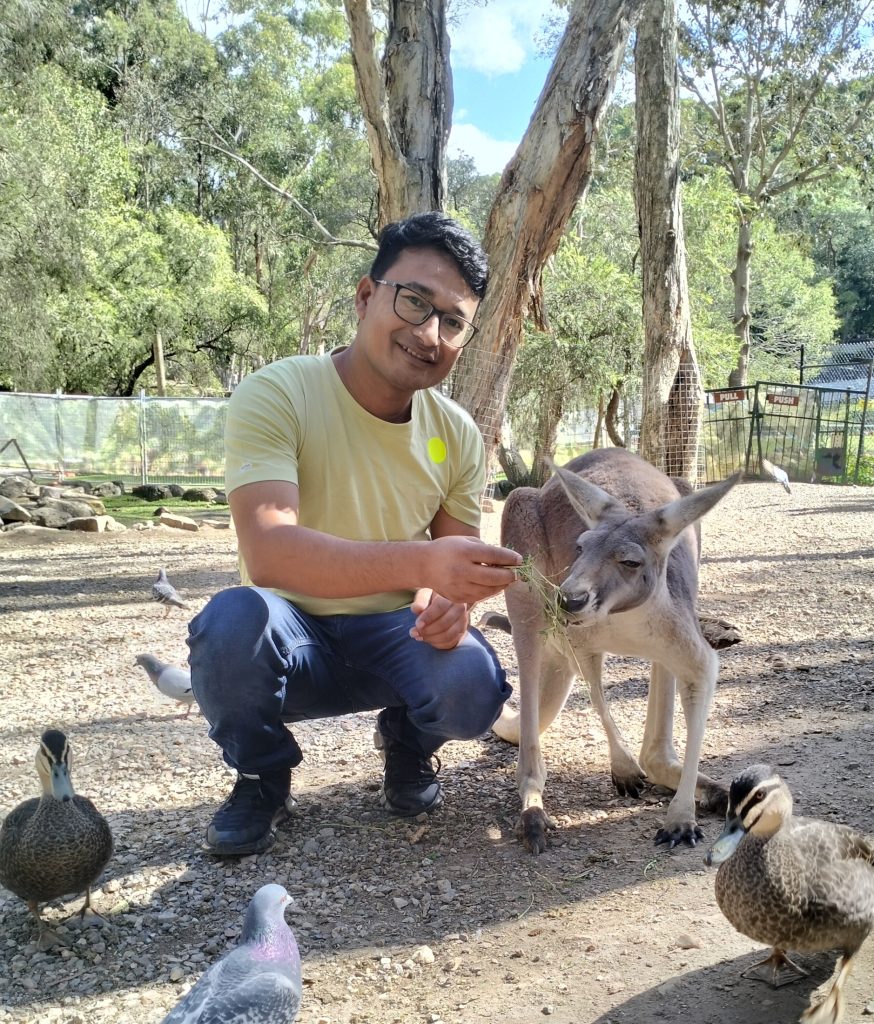
Melsan feeding a kangaroo at Brisbane Forest Park during a field visit organised under the Australia Awards Short Course.
A key learning highlight involved integrating GEDSI considerations into climate and disaster programming. While Melsan’s initial survey lacked GEDSI depth, guidance from his mentors inspired focused assessments with women, Dalit communities and people with disability, improving inclusiveness and quality.
Melsan also credits the Short Course with enhancing his skills in designing community-centred research, analysing linkages between climate change adaptation and disaster risk reduction, and documenting adaptation practices. “These competencies directly informed my Return-to-Work Plan and contributed to an academically rigorous and policy-relevant publication, ultimately strengthening climate-resilient livelihoods in Kapilvastu,” he says.
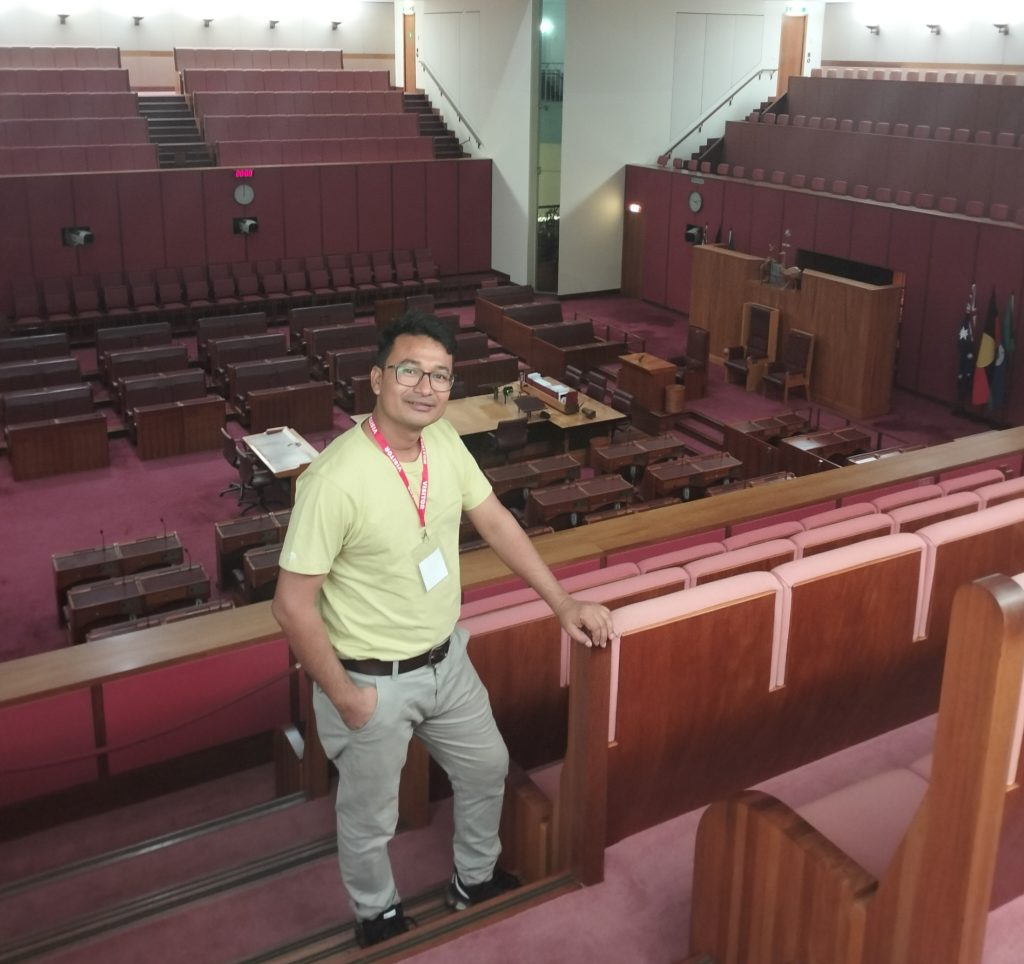
Melsan inside Australia’s Parliament House in Canberra, participating in an educational visit organised under the Australia Awards Short Course.
Speaking about having his work featured in The Journal of Environment & Development, Melsan says, “Publishing my article in this journal underscores the academic quality and international relevance of my Return-to-Work Plan findings.”
The article is accessible at https://doi.org/10.1177/10704965251393334.