

Nepali officials learning from Australia’s forest fire management practices
Posted: 30 May 2025
A delegation of 15 Nepali officials recently participated in a study tour to learn from Australia’s forest fire management practices. The tour took participants to Canberra, Melbourne and Victoria’s north-east region from 16 to 23 March 2025. Australia Awards supported the tour under the Australian Professional Opportunities program, with the aim of enhancing knowledge and strengthening best practices in fire management.
The delegation included representatives from the Ministry of Home Affairs, Ministry of Forests and Environment, Armed Police Force (Gandaki Province, Disaster Management Team), Nepal Army (Disaster Management Battalion), President Chure Terai-Madhesh Conservation Development Board, Federation of Community Forestry Users Nepal, Worldwide Fund for Nature – Nepal, International Centre for Integrated Mountain Development (ICIMOD) and ForestAction Nepal. The tour provided an opportunity for hands-on learning from Australia’s advanced wildfire preparedness and response systems at national, regional and local levels.
Australia has a longstanding partnership with Nepal in the forestry sector that dates back to 1966, including the Nepal–Australia Forestry Project in 1976. Recognising the growing threat of wildfires in Nepal, Australia continues to share its expertise to help Nepal develop effective fire management systems.
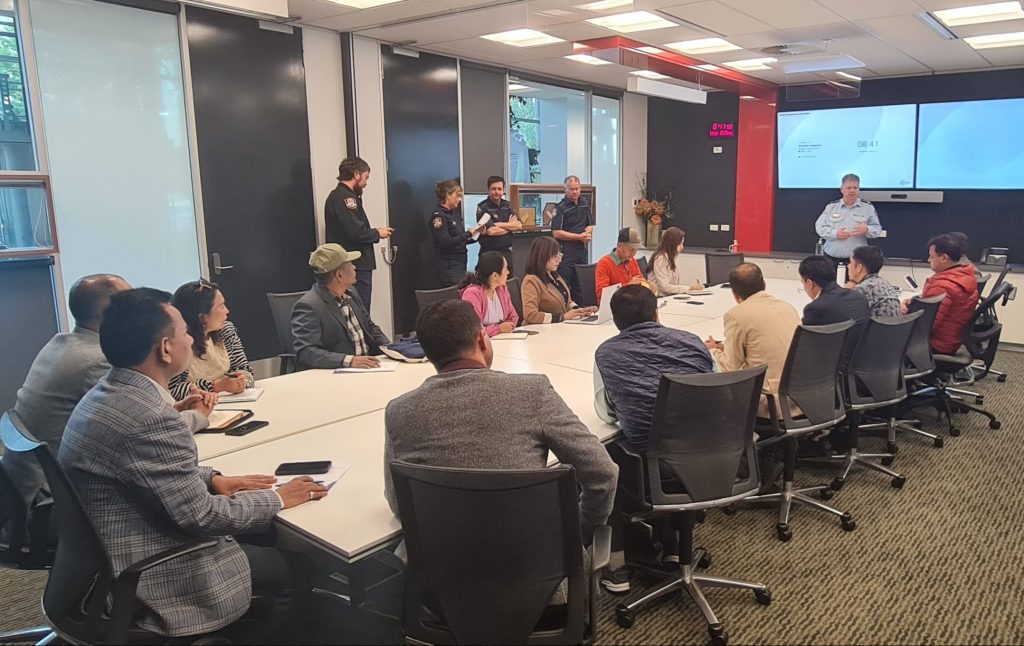
At the Australian Capital Territory Emergency Services, Nepali officials learnt the role of the Emergency Services Agency and its services, including the Hume Helibase and community fire units.
The study tour offered a range of learning experiences, including presentations on Australian fire management and the 2003 Canberra bushfires, which were the most destructive in the Australian Capital Territory’s history. The participants also benefited from site visits and engagements with the Commonwealth Scientific and Industrial Research Organisation (CSIRO), the University of New South Wales and the Australian National University’s Fenner School of Environment & Society, as well as discussions about climate-driven fire behaviour and advanced technologies.
The Nepali officials explored bushfire management with the Australian Capital Territory Emergency Services and learnt about fire suppression and community safety in Victoria through agencies such as Emergency Management Victoria and the Country Fire Authority. They toured the Mansfield Country Fire Authority Fire Station, visited sites still recovering from the 2009 bushfires—Australia’s most devastating ‘Black Saturday’ bushfires, and gained insights into fire preparedness strategies.
Learning sessions at the Department of Energy, Environment and Climate Action office in Alexandra featured presentations on fuel management and firefighting logistics, following which the participants visited Marysville’s burning operations. The group observed aerial firefighting at Walsh’s Air Base, visited a remote fire-spotting cabin at Mount Buller, analysed recent fire impacts at Swanpool-Lima and Boho sites, and discussed grassfire management at the Country Fire Authority Incident Control Centre in Seymour. The tour concluded with the participants delivering presentations on key takeaways and individual commitments, emphasising their dedication to enhancing fire management strategies in Nepal.
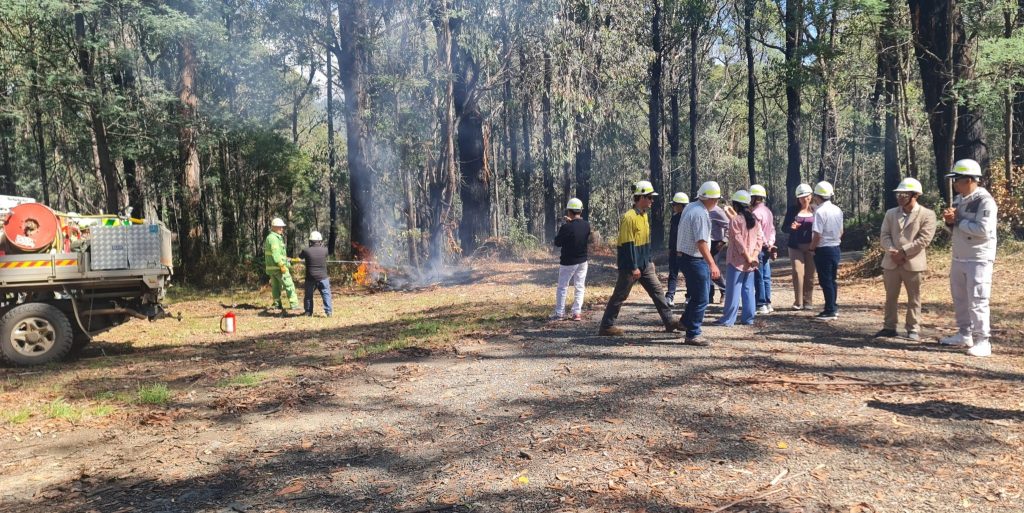
Nepali officials learning from the team at Forest Fire Management Victoria about their role in Victorian fire management and fire preparedness arrangements.
As a tangible output of the tour, the group developed a discussion paper that highlights key observations, recommendations for Nepal’s wildfire management and areas where donor support could be the most impactful. The paper recommends:
- identifying scalable good practices and community-led solutions
- integrating scientific and traditional knowledge
- strengthening institutional frameworks and inter-agency coordination
- establishing a dedicated forest fire management unit
- promoting inclusive community engagement, especially involving women and marginalised groups.
Australian Professional Opportunities are professional development and capacity building opportunities funded by the Australian Government and offered by Australia Awards – South Asia & Mongolia.
Photos of the gallery below:
1,2,3- At the Australian Capital Territory Emergency Services Agency, Nepali officials learnt the role of the agency and its services, including the Hume Helibase and community fire units.
4- Nepali officials at Emergency Management Victoria’s State Control Centre, learning how the Centre operates during the bushfire period, including during emergencies.
5,6,7- Nepali officials learning from the team at Forest Fire Management Victoria about their role in Victorian fire management and fire preparedness arrangements.
8,9- Nepali officials, with Mansfield Country Fire Authority Fire Station team officials, interacted with volunteer firefighters and visited Walsh’s Air Base to understand aerial firefighting operations.
10- Nepali officials visiting Seymour’s Country Fire Authority Incident Control Centre.
11- After the study tour, Luna Purification (Head of Development at the Australian Embassy, Kathmandu) met with several participants at an Experience Sharing session, where they shared key learnings from the tour.