

Nepali alum champions Scholarship opportunities for sexual and other minority groups
Posted: 2 April 2026
Shailee Chaudhary completed a Master of Human Rights Law at the University of Melbourne in 2025 with the support of an Australia Awards Scholarship. Shailee is a human rights and social justice leader with over a decade of experience advocating for socially excluded communities. Her work has focused on LGBTQIA+ rights, gender justice, caste equity and Madhesi dignity. Shailee has also held leadership roles in student governance and civil society, contributing to the creation of inclusive, rights-affirming spaces across academic and community settings.
Below, Shailee reflects on her Australia Awards journey and encourages prospective applicants, particularly those from sexual and other minority groups, to consider applying for the Australia Awards Scholarship as a pathway to earning a globally recognised degree in Australia.
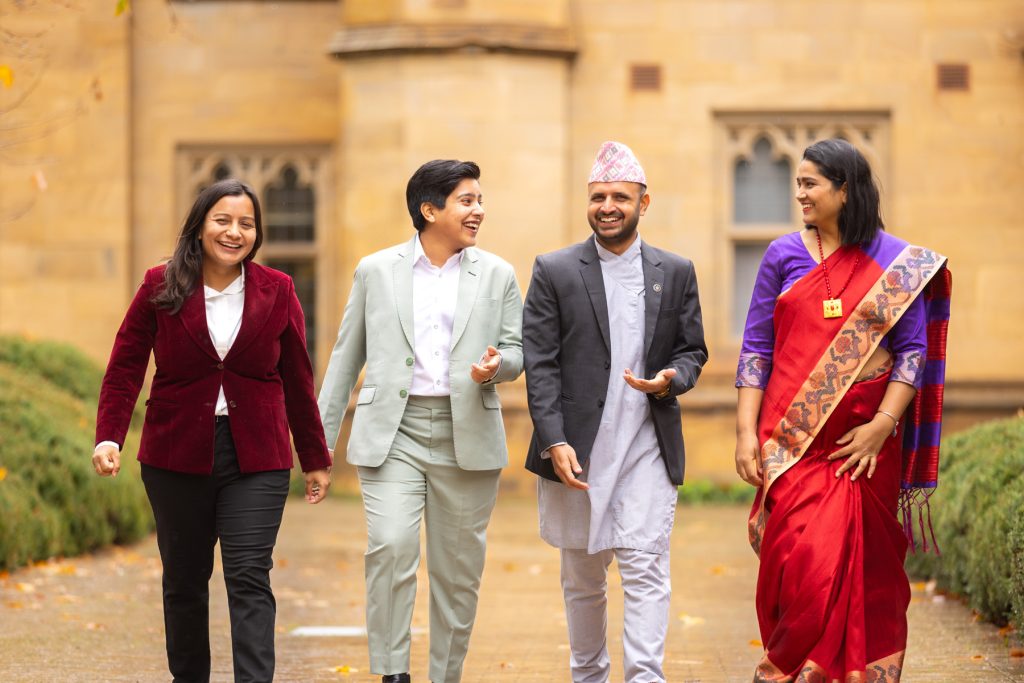
Shailee (second from left) pictured with other Australia Awards scholars from Nepal in Melbourne.
What inspired you to pursue a Master of Human Rights Law at the University of Melbourne, and in what ways did the Australia Awards Scholarship support you in achieving that degree?
For over a decade, I have dedicated myself to championing the rights of marginalised communities, Dalits, Madhesis, women, LGBTQIA+ individuals and socially excluded groups. As a Madhesi Marwari Queer person, discrimination has not been an abstract concept for me; it has been lived, felt, and carried in my body and mind every single day. That personal experience became the fire behind my professional purpose.
As I deepened my advocacy work, I understood that to truly serve the communities I care about, I needed stronger tools—legal literacy being the most powerful among them. But pursuing a Master of Laws in Nepal came with an almost impossible condition: a prior law degree, which I did not have. That door felt firmly shut.
Australia Awards opened a window I did not know existed. It did not just fund a degree; it validated that someone like me, from a minority background, without a conventional legal education path, could compete for a seat at one of the world’s most prestigious universities. The University of Melbourne gave me academic rigour, and Australia Awards gave me the belief that nothing is out of reach when you are driven by purpose and prepared to work for it.
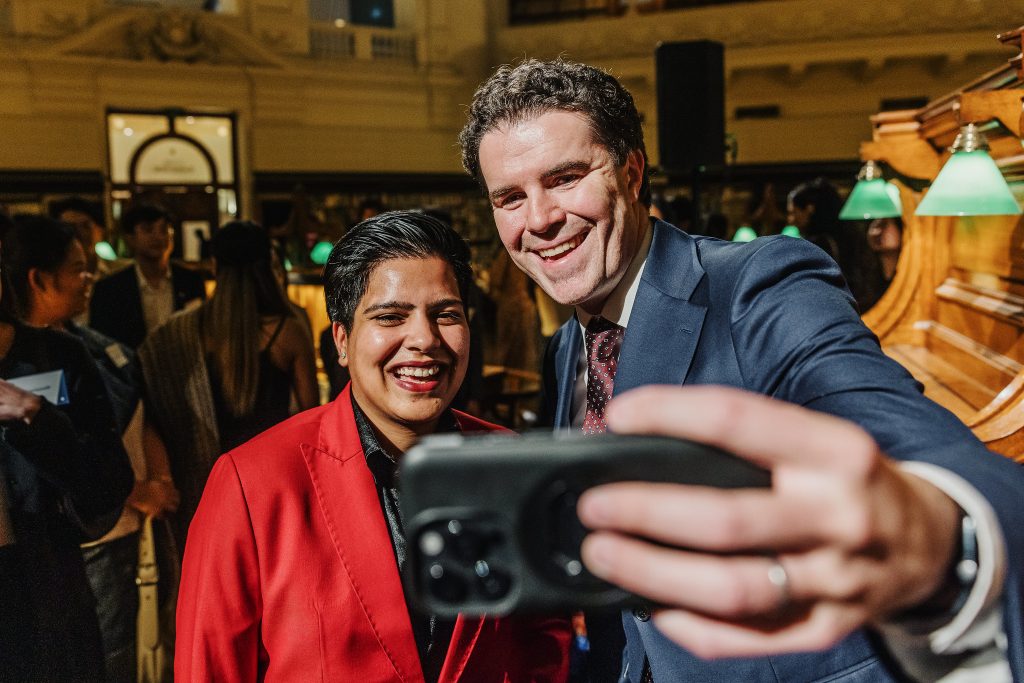
Shailee (left) taking a selfie with the Hon Tim Watts MP, Australia’s Special Envoy for Indian Ocean Affairs and a Member of Parliament, at the 2025 Australia Awards End of Year celebration in Melbourne.
Looking back, can you describe your experience as a scholar, particularly from an equity and inclusion perspective?
Walking into an Australian classroom for the first time, I expected to feel like an outsider—a student from a small, landlocked country who had somehow found themselves in a world-class institution. But that feeling of ‘not belonging’ never came.
What I found instead was a learning environment that genuinely celebrated difference. My ideas were not just tolerated; they were invited, engaged with, and built upon. When I spoke about the realities of caste-based discrimination or the violence faced by LGBTQIA+ communities in South Asia, my peers and professors leaned in with curiosity rather than dismissal. For someone who has often had to justify their very existence in rooms back home, it felt quietly revolutionary.
I also witnessed, perhaps for the first time, what true inclusion looks like when it is not performative. It is not about ticking diversity boxes or adding a token voice to a panel. It is about structuring systems, classrooms, institutions and policies so that every person feels they genuinely belong. That experience has permanently shifted how I think about advocacy. I carry that lesson with me now, not just as an ideal, but as a standard I hold myself and my work to every day.
How has studying in Australia shaped your views on inclusion, advocacy and your role in advancing the rights of traditionally marginalised groups, including sexual minority communities?
Australia stretched me in ways I did not anticipate. My classmates came from different countries, cultures, gender identities, racial backgrounds and lived experiences. Sitting in those rooms, I began to see how the struggles of marginalised communities, while unique in their local context, are deeply connected across borders. Oppression has patterns. So does resistance.
I was intentional about the subjects I chose, selecting courses that directly intersected with human rights, discrimination law and social justice. But the learning that moved me most was not always found in textbooks. It came through conversations with a refugee lawyer from Kenya, a feminist Indonesian scholar studying law, and a queer activist from the Pacific. These exchanges expanded my understanding of what advocacy can look like and how much richer it becomes when it is genuinely intersectional.
Studying in Australia also gave me the language and legal frameworks to articulate injustices I had always felt but sometimes struggled to name. That clarity is powerful. It means I can now walk into a courtroom, a policy room or a community meeting and argue with both the heart of someone who has lived these realities and the precision of someone trained to dismantle the systems that create them. That combination is what I want to bring back to Nepal.
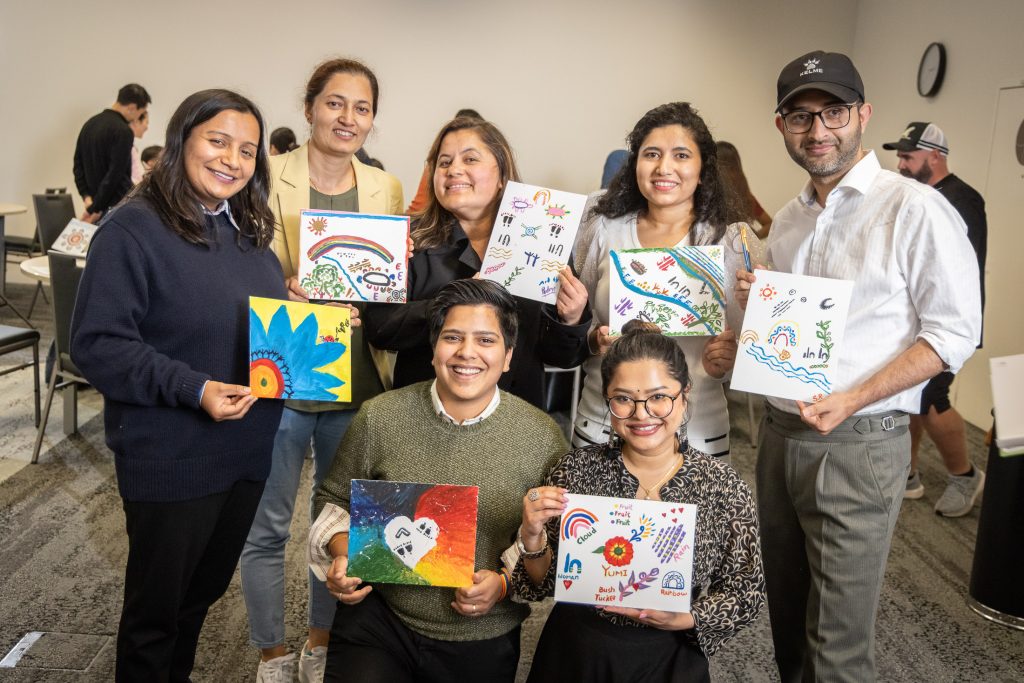
Shailee (front row, left) pictured with other Nepali scholars after participating in an Indigenous art workshop under the guidance of a First Nations artist during the 2025 Australia Awards – South Asia and Mongolia Scholars Symposium in Melbourne.
What message or advice would you share with prospective applicants from traditionally marginalised groups and sexual minority communities in Nepal who may feel hesitant about applying for an Australia Awards Scholarship?
Please apply. I mean that sincerely, not as a formality.
I know the hesitation. I know what it feels like to look at an opportunity and think, “This is not meant for people like me.” When you have spent your life navigating systems that were not built with you in mind, it is easy to pre-emptively disqualify yourself before anyone else gets the chance to. But here is what I want you to hear:
Australia Awards exists precisely for people like us. The most marginalised, the most overlooked, the most underestimated. We are not exceptions to the Scholarship. We are its purpose.
Yes, the application process is demanding. It asks a lot of you, and there are moments when it will feel like too much. But be honest. Be specific. Do not shrink yourself to fit what you imagine they want to hear. Bring the full, complicated, beautiful truth of who you are and what you have fought for. That authenticity is not a weakness; it is your greatest strength.
And when you get to the other side, because I believe you will, you will look back and realise that everything you endured during the application was just the beginning of something that will change your life in ways you cannot yet imagine. Take the first step. The rest will follow.
How do you plan to apply the knowledge, skills and networks you gained through your Australia Awards Scholarship in your future work?
An Australia Awards Scholarship does not end when you hand in your final assignment or board a flight home. It becomes part of who you are: a lifelong commitment, a permanent shift in perspective and, yes, a community you carry with you wherever you go.
The network I built through this experience is one of my most treasured assets. These are not just professional contacts; they are brilliant, compassionate people who have seen the world from radically different angles, who challenge me, support me and remind me of what is possible. When I face a difficult legal question or a complex advocacy challenge, I know I have a community of minds I can turn to.
As for the knowledge itself, I plan to use it exactly where it is needed most. I want to work with the communities that have shaped my life: Dalit communities, Madhesi communities, women and LGBTQIA+ individuals navigating a legal system that was rarely designed with them in mind. My Master of Human Rights Law has given me the tools to do that work with greater depth and confidence. I plan to combine this formal legal qualification with the grassroots experience I hold. The goal has always been the same: To build a more just Nepal and world—one case, one policy, one community at a time.