

Nepali conservationist empowered to restore key ecosystems
Posted: 5 March 2026
Lokendra Adhikari from Nepal recently completed a Master of Environment (Conservation and Restoration) with distinction at the University of Melbourne with the support of an Australia Awards Scholarship.
Lokendra was featured as the ‘face’ of the Australia Awards promotions in Nepal for study commencing in 2027. We recently caught up with him to ask about his Scholarship journey, how it has affected his personal and career growth, and what advice he has for prospective applicants.
Why did you apply for an Australia Awards Scholarship?
My professional journey as a Conservation Officer with the Government of Nepal, particularly within the protected areas management system, provided me an opportunity to understand both conservation successes and persistent challenges. While Nepal has successfully doubled the populations of flagship species, this achievement has intensified human–wildlife conflict, especially in communities living adjacent to protected areas. I worked closely with impoverished and ecosystem-dependent communities around protected areas. I witnessed how overlapping land use, unclear zoning, devastating climate change and weak planning without considering critical ecosystems have increased confrontation between people and wildlife. Nepal’s protected areas network conserves only 80 of the country’s 118 ecosystem types, leaving many critical ecosystems fragmented and ecologically degraded. Inadequate technical knowledge, poor mapping of critical ecosystems, and infrastructure development without green planning in critical ecosystems further exacerbate these issues. I realised that addressing these complex conservation challenges requires strong technical expertise combined with social and policy understanding.
Australia Awards Scholarships offered in 2024 listed climate change and natural resource management as one of the priority areas for Nepal, which aligned directly with my goal of developing technical competence in natural resource management. Besides, the Scholarship’s focus on leadership, strong alumni networks and reintegration support offer a transformative platform to translate knowledge into action. These factors encouraged me to apply for the prestigious Australia Awards Scholarship. For me, Australia Awards is not merely a degree opportunity; it is a pathway to deliver inclusive, science-based conservation solutions for Nepal.

Lokendra (third from left) pictured with other Nepali scholars in Melbourne.
How did your Australia Awards Scholarship contribute to your personal and professional growth?
The Australia Awards Scholarship has been transformative for both my personal and professional growth. Academically, it equipped me with advanced technical knowledge, analytical skills and practical tools in natural resource management, enabling me to critically assess complex conservation challenges through evidence-based and interdisciplinary approaches. Exposure to contemporary research, field-based learning and policy-oriented coursework strengthened my capacity to design sustainable and context-specific solutions relevant to Nepal’s protected areas management system.
This program equally emphasised leadership and professional development. Events such as the Australia Awards – South Asia & Mongolia Scholars Forum in Canberra provided a unique platform to engage with peers from diverse countries and sectors, fostering cross-cultural understanding, collaboration and shared learning. These interactions enhanced my communication, teamwork and leadership skills, while broadening my perspective on global development challenges and innovative responses.
On a personal level, living and studying in Australia increased my confidence, independence and adaptability. Navigating a multicultural academic environment strengthened my resilience and problem-solving abilities, while exposure to inclusive governance and community-based conservation models reshaped my professional values.
Overall, the Australia Awards Scholarship went far beyond academic training. It enabled me to grow as a reflective practitioner and emerging leader, well-prepared to translate knowledge into action and contribute meaningfully to sustainable development and conservation outcomes in my home country.
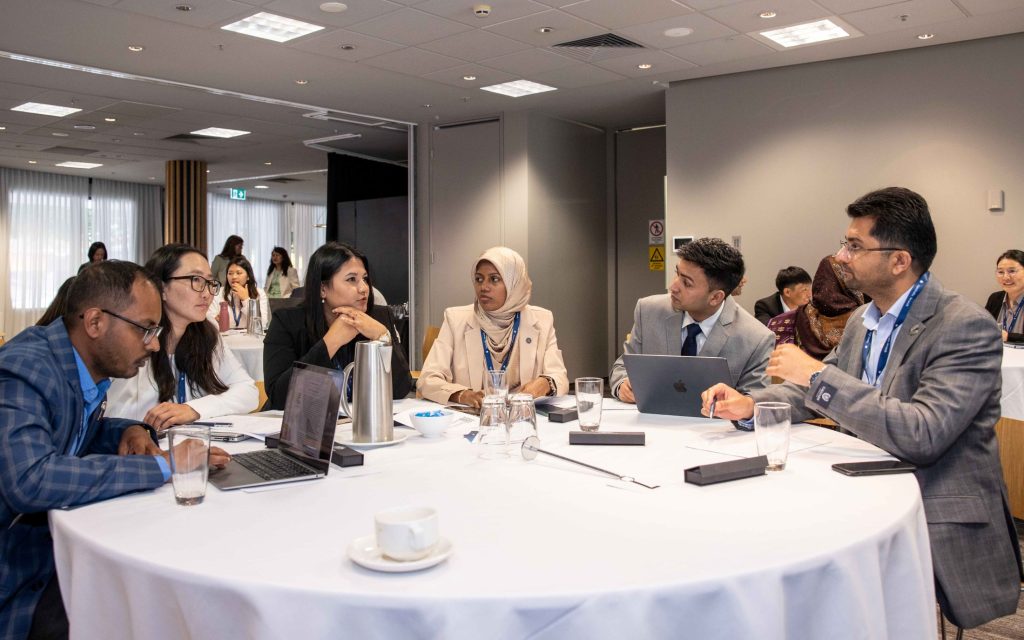
Lokendra (second from right) participating in the 2024 Scholars Forum in Canberra.
University aside, what was your life in Australia like?
Life in Australia outside the university environment was enriching, balanced and personally meaningful. I spent much of my time exploring Melbourne, a city known for its cultural diversity, green spaces, and strong connections between urban life and nature. Given my professional interest in natural resource management, I frequently visited botanical gardens, beaches, national parks and conservation reserves, which allowed me to observe Australia’s approach to landscape and ecosystem management beyond the classroom.
During academic breaks, I travelled interstate to better understand how land-use planning and landscape management are implemented across different ecological and governance contexts. These experiences strengthened my practical understanding of integrated conservation approaches and reinforced lessons learnt through my studies.
Living in Australia also provided a rare opportunity for me to spend quality time with my spouse—something that had been challenging to do in Nepal due to my work commitments in remote rural areas. This period greatly enhanced my work–life balance and personal wellbeing. Exploring Melbourne’s vibrant cityscape, multicultural food culture and community life further enriched my experiences.
In addition, I actively engaged in community engagement. I spent significant time working in a glasshouse for my research work, where I conducted a year-long project examining the effects of wildfire on plant diversity in Victoria’s forests. Overall, life outside the university was transformative, fostering personal growth, cultural understanding and deeper professional insight.
Now that you have returned to Nepal after graduating, how are you contributing to your home country’s development?
Having returned to Nepal, my plans to contribute to national development are firmly grounded in my role as a government employee and aligned with the country’s development priorities. My academic and career pathway are driven by Nepal’s urgent need for effective ecosystem management and biodiversity conservation. I intend to continue working in this field, with a strong focus on identifying, restoring and rehabilitating critical ecosystems, particularly in the lowlands of Nepal.
Restoration of degraded ecosystems will enhance ecological functionality and improve water-cycle regulation, ensuring long-term water availability and reducing ecosystem vulnerability. These interventions will serve as nature-based solutions for climate change adaptation and mitigation, while supporting the development of climate-resilient communities. In parallel, I plan to integrate ecosystem restoration with alternative livelihood and income-generation opportunities for pro-poor, ecosystem-dependent communities, contributing to poverty reduction and social equity.
Evidence generated from these initiatives will be translated into policy briefs to support informed decision-making and promote critical ecosystems and their value at both community and national levels. These efforts will directly contribute to my country’s international commitments under the Convention on Biological Diversity. Ultimately, I plan to contribute to the achievement of United Nations Sustainable Development Goals 15 (Life on Land) and 13 (Climate Action) through inclusive, science-based ecosystem management.
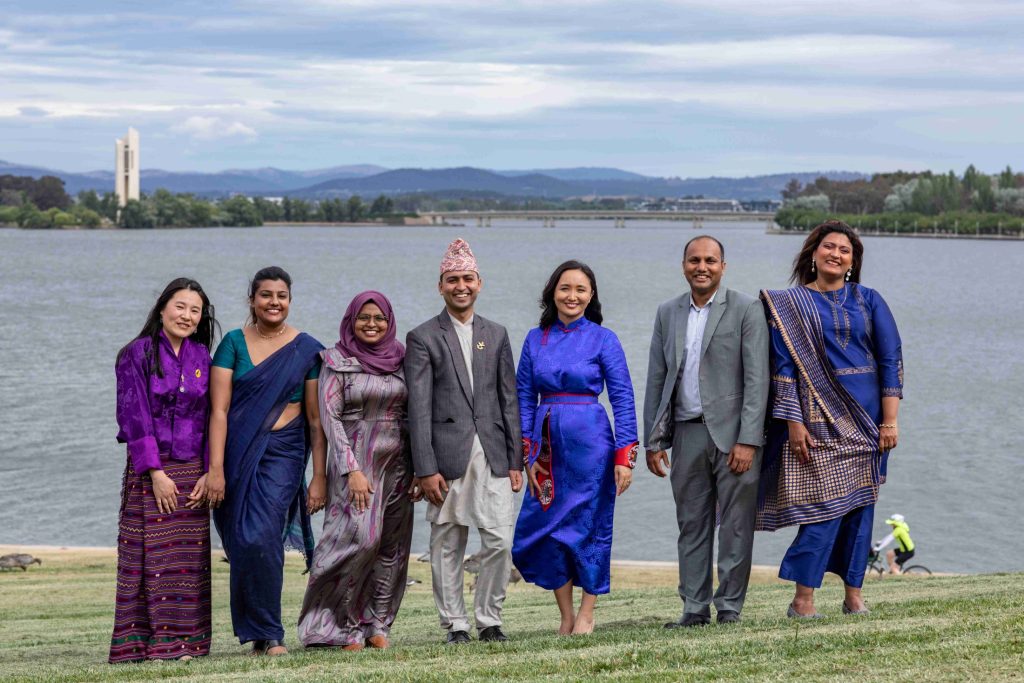
Lokendra (middle) pictured with other Australia Awards scholars from South Asia and Mongolia in Canberra.
What advice would you give to anyone thinking of applying for an Australia Awards Scholarship?
First, I would like to thank you for taking the time to read my story. Now it is your turn to take the step towards becoming an Australia Awards scholar. I strongly encourage you to begin by clearly identifying the key challenges in your professional field and ensuring they align with the Australia Awards priority sectors. A strong application is grounded in clarity of purpose and relevance. Invest time in reviewing current literature and research to understand existing gaps related to your identified challenge. This will help you develop a well-structured and evidence-based Development Impact and Linkages Plan. The Australia Awards Scholarships Policy Handbook is an essential guide to understanding expectations, eligibility and selection criteria.
Be well-prepared with concrete evidence of your professional experience, achievements and impact. Do not hesitate to use the ‘Find an Expert’ pages on university websites to identify potential supervisors who share your research interests and could support your academic journey. Connecting with previous Australia Awards recipients is equally valuable; you can access alumni networks through the official Australia Awards website, LinkedIn and other professional platforms.
Having lived and worked in some of Nepal’s most remote regions, including the Karnali region, I strongly encourage eligible candidates outside of Kathmandu not to underestimate themselves. Many talented individuals in rural areas believe such opportunities are beyond their reach due to limited English proficiency or academic exposure. However, what they may lack in formal advantages, they often possess in practical skills, resilience, local knowledge and community-based leadership, which strongly align with the values of Australia Awards. Australia Awards – Nepal also organises provincial-level workshops and information sessions, and rural applicants should actively participate whenever possible. Given limited access to electricity and stable internet, I advise rural candidates to prepare early, gather documents in advance and avoid last-minute submissions, as system congestion can pose challenges.