

Alum contributing to cancer care in Nepal through radiotherapy
Posted: 21 April 2026
Australia Awards alum Rajeev Karn is a Supervisor Therapy Radiographer at Bhaktapur Cancer Hospital. Having joined Bhaktapur Cancer Hospital in 1999 and steadily progressed since then through several radiotherapy roles to his current senior position, Rajeev has nearly 27 years of dedicated experience in medical radiation therapy. His longstanding service and contributions were recently recognised by the hospital.
In 2013, Rajeev received the prestigious Australia Leadership Award Fellowship (a precursor to Australia Awards Fellowships), a milestone he continues to cherish as recognition of his dedication to cancer care. Through this Fellowship, he completed an intensive training program at the University of Sydney and the Northern Sydney Cancer Centre, where he gained both theoretical knowledge and practical expertise in radiotherapy. More than a decade later, the memories remain vivid for him. He recalls the well-structured curriculum, the highly devoted mentors, and the exceptional teaching methods that provided clear, meticulously planned learning pathways for every participant.
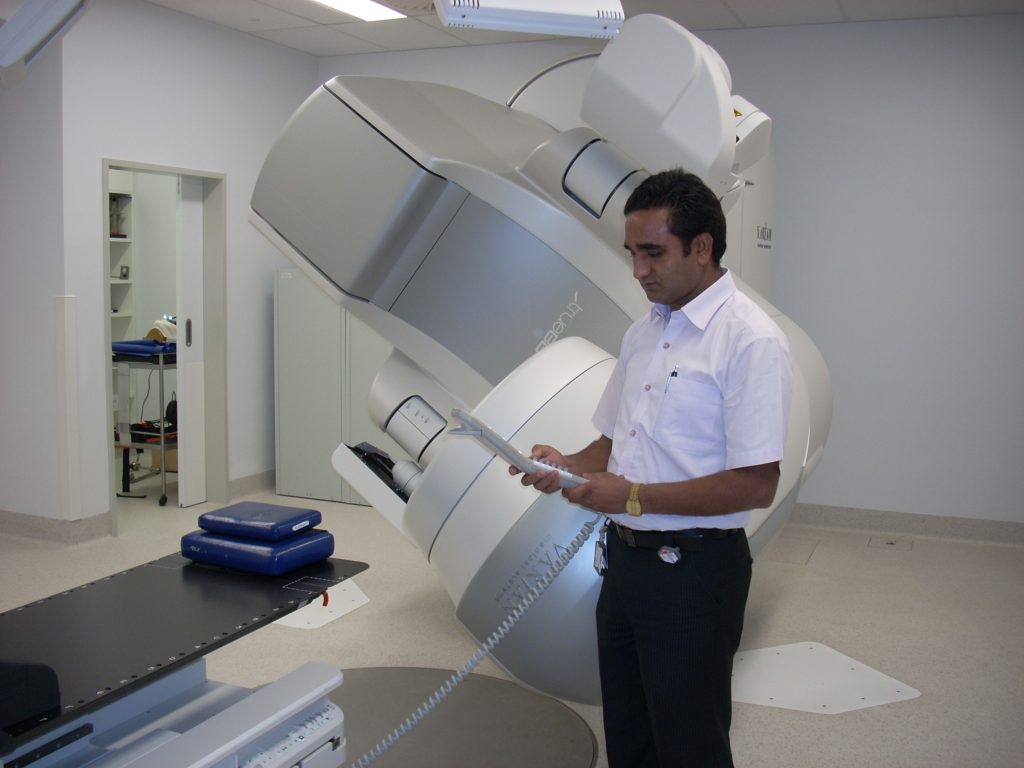
Rajeev testing equipment at the Royal North Shore Hospital in Sydney during his Fellowship in Australia.
Born and raised in Janakpur, a city long celebrated for its rich Mithila heritage and more recently declared the capital of Madhesh Province, Rajeev grew up as the youngest of six siblings in an academically nurturing household. He benefited from a home library curated by his father—a teacher and writer—which kept him, in his own words, “informed about national and international affairs” from an early age.
After completing high school, Rajeev moved to Kathmandu to pursue radiology at the Institute of Medicine’s Maharajgunj Campus. His qualification was in high demand and led to immediate employment. He initially served the Government of Nepal in Mahakali Zonal Hospital in Mahendranagar and then Sarlahi District Hospital in Malangawa, but soon realised these roles were not challenging enough. “In search of a professional growth opportunity, I looked up Kathmandu again and grasped a position in Bhaktapur Cancer Hospital in March 1999,” he recalls.
At the time of his arrival at Bhaktapur Cancer Hospital, Nepal’s radiation therapy services were still nascent. Before Bhaktapur Cancer Hospital, these services were available only at Bir Hospital—and even then, only with limited infrastructure. Many Nepalis viewed cancer as an almost certainly fatal condition due to the lack of treatment facilities, pushing those who could afford it to seek care abroad. Rajeev describes his Bhaktapur Cancer Hospital appointment as both meaningful and motivating. “This was a very exciting offer for me to be a part of such an important mission in the country,” he says. “I was excited to learn new things and to be a part of a decent occupation.”
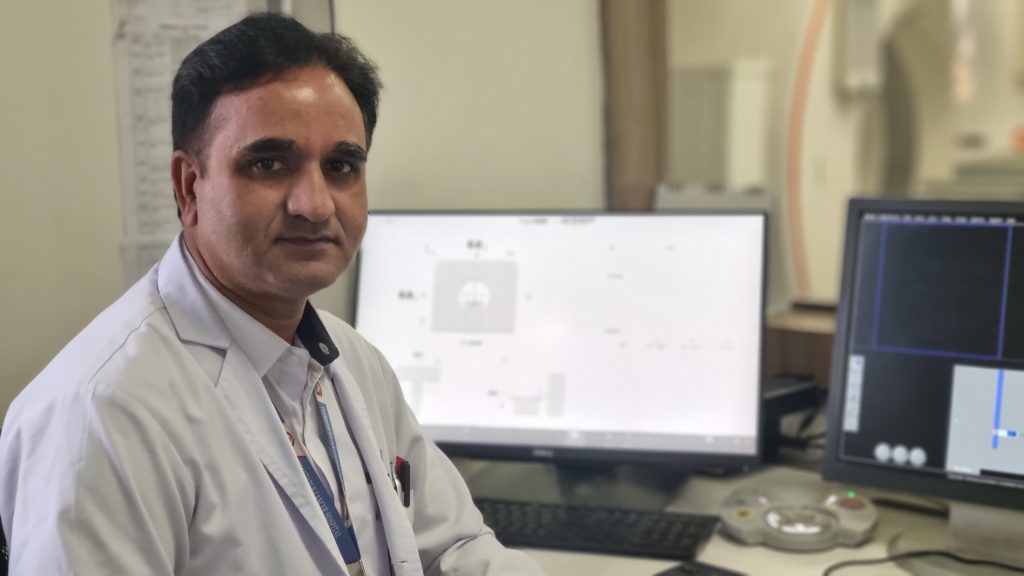
Rajeev pictured at his workstation in Bhaktapur Cancer Hospital.
Cancer has increasingly become a major public health concern both globally and in Nepal. The World Health Organization reported approximately 20 million new cases and 10 million deaths worldwide in 2022. Nepal alone recorded more than 22,000 new cases and over 14,700 deaths in the same year. Studies indicate that Nepal’s cancer burden has nearly doubled since 1990. Rajeev notes that this rising trend is clearly visible at Bhaktapur Cancer Hospital, where the daily number of patients has grown from just 10–15 in the early years to as many as 170 now.
As a Therapy Radiographer, Rajeev’s role is central to cancer care in Nepal. Radiation therapy is a type of cancer treatment that uses high-energy radiation to kill cancer cells or stop them from growing. It is one of the most common cancer treatments, often used alongside surgery, chemotherapy or immunotherapy. Rajeev notes that “more than two-thirds of the cancer-diagnosed patients need radiation therapy treatment”. Due to high national demand and limited equipment, his department frequently manages nearly three times the normal patient capacity.
On one occasion, Rajeev says that he and his team managed external beam radiotherapy treatment to “as many as 128 patients in a single day, despite the World Health Organization recommending that only six patients be treated per hour with one treatment delivery machine”, which he notes is equivalent to just 35–40 patients per day under normal working conditions. To ensure that delays do not compromise treatment outcomes, the team routinely works late into the night, sometimes until 2:00 am. When asked why they continue despite immense pressure, Rajeev responds with one word: “Responsibility.” His dedication, combined with deep professional passion, continues to drive his contributions to cancer care in Nepal. Over the course of his career at Bhaktapur Cancer Hospital, he has provided external beam radiotherapy to more than 25,000 cancer patients, reflecting his unwavering commitment to the field.
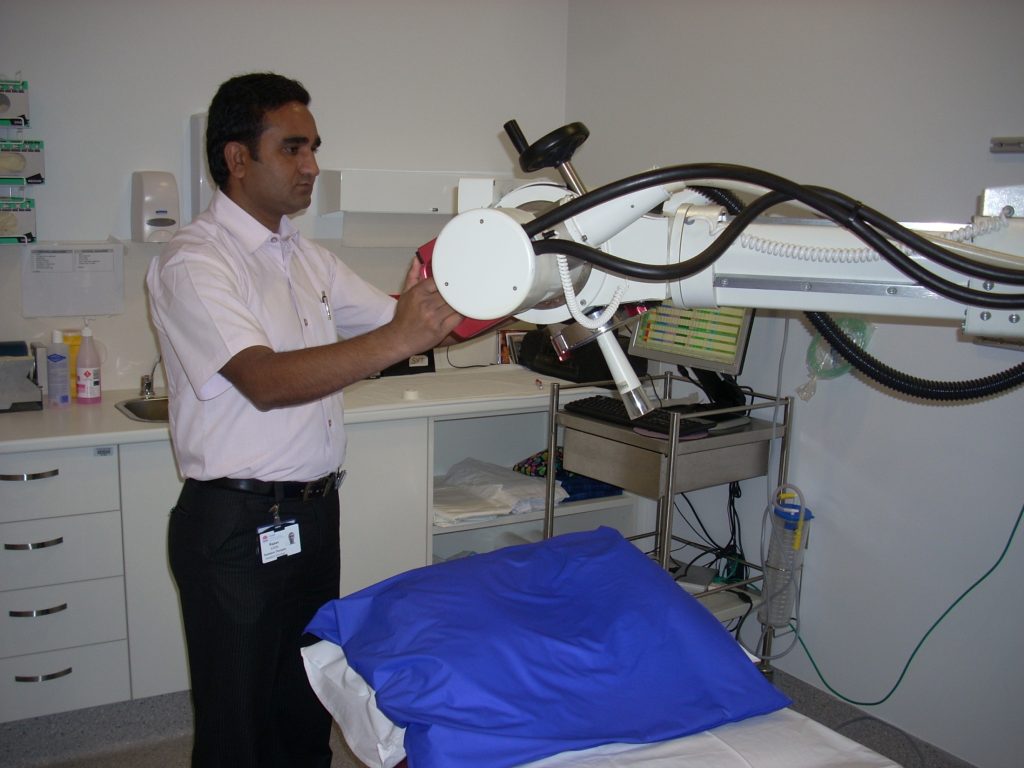
Rajeev during his Fellowship in Australia.
Rajeev believes that the exposure and experience he gained through the Australia Leadership Award Fellowship significantly enhanced his professional capacity and leadership abilities. Beyond performing his regular duties, he has applied the skills acquired during the Fellowship to enhance the quality of services at Bhaktapur Cancer Hospital. For example, he introduced the Field Size Reduction technique in the second and third phases of treatment to protect patients from unnecessary radiation exposure and reduce the risk of severe side effects. He also initiated weekly counselling sessions to help patients better understand potential side effects and adopt appropriate self-care practices. In addition, Rajeev regularly mentors national and international elective students and interns who come to Bhaktapur Cancer Hospital to learn about radiation therapy. He remains closely connected with his Fellowship mentor, Craig Opie, whom he first met at the Royal North Shore Hospital in Sydney. Rajeev also actively participates in global radiotherapy discussions coordinated through the Asia-Pacific Radiation Oncology Network.
Australia Awards offers esteemed international Scholarships, Fellowships and Short Courses funded by the Australian Government’s Department of Foreign Affairs and Trade. These opportunities are designed to nurture emerging leaders in developing countries through advanced studies and training opportunities in Australia. Graduates become part of a distinguished global network of alumni, recognised for their influence and contributions in their fields. Rajeev’s impactful work in strengthening Nepal’s fight against cancer stands as a powerful example of the meaningful contributions made by Australia Awards alumni.