

Finding her path through a transformative experience in Australia
Posted: 12 February 2026
Sujita Dhakal from Nepal completed a Master of Development Studies at the University of Melbourne in Victoria, with the support of an Australia Awards Scholarship.
In the following video, Sujita discusses her experiences as an Australia Awards scholar in Australia.
“My Australia Awards journey has been transformative,” says Sujita, who specialised in gender and development within her master’s degree. “My course is an amalgamation of theoretical and the practical knowledge of inclusive development … It has equipped me with the leadership skills, knowledge and the critical thinking I need to lead on inclusive development back home.”
As examples of what she hoped to achieve with her new learning and networks, Sujita mentioned “integrating gender into the natural resource management sector back in Nepal”, as well as supporting “locally-led climate adaptations”.
When she first arrived in Australia, Sujita found some pleasant surprises in the classroom. “It was a really new academic culture here,” she says. “You are allowed to make mistakes … The teaching method here is really student-centred and non-hierarchical between the professors and students.”
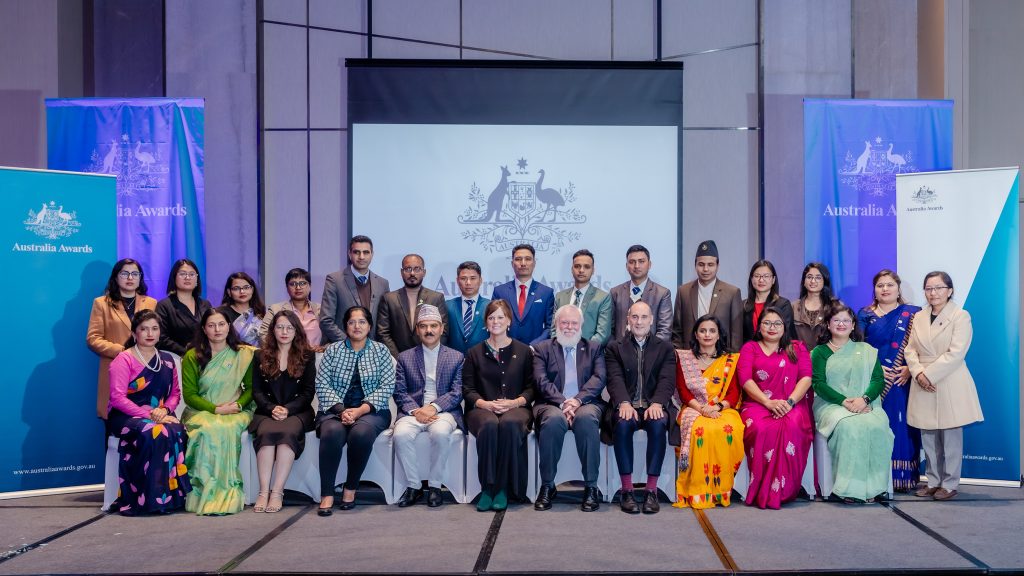
Sujita (front row, far right), at the pre-departure briefing held in Nepal in 2023 prior to her travel to Australia.
In Nepal, Sujita had studied STEM (science, technology, engineering and mathematics) but her degree in Australia was in the Faculty of Arts, so she had some adjusting to do. “When I started,” she notes, “I was googling so many words I studied in the class or the readings.” But the environment and teaching style she experienced in Australia, Sujita says, “made me really comfortable to ask [for] support”. She adds, “I was not afraid to ask questions with the teachers, and they really initiated a co-learning space.”
The level of support provided to scholars made a strong impression on Sujita. “I received [a] plethora of support from [the] Australia Awards team and the university right from the beginning,” she says, highlighting the work of the Australia Awards team in Nepal before she arrived in Australia, such as conducting briefings with experts in different sectors to familiarise scholars with various safety policies and equip them with the knowledge needed to adjust to a different culture in Australia.
“Regarding the support outside the university degree, [the] Australia Awards team has provided different soft skills trainings for us,” Sujita adds, mentioning peer learning opportunities such as panel discussions and workshops to develop presentation skills. “Apart from that, Australia Awards has also supported me in attending a conference where I will be … presenting my research paper.”
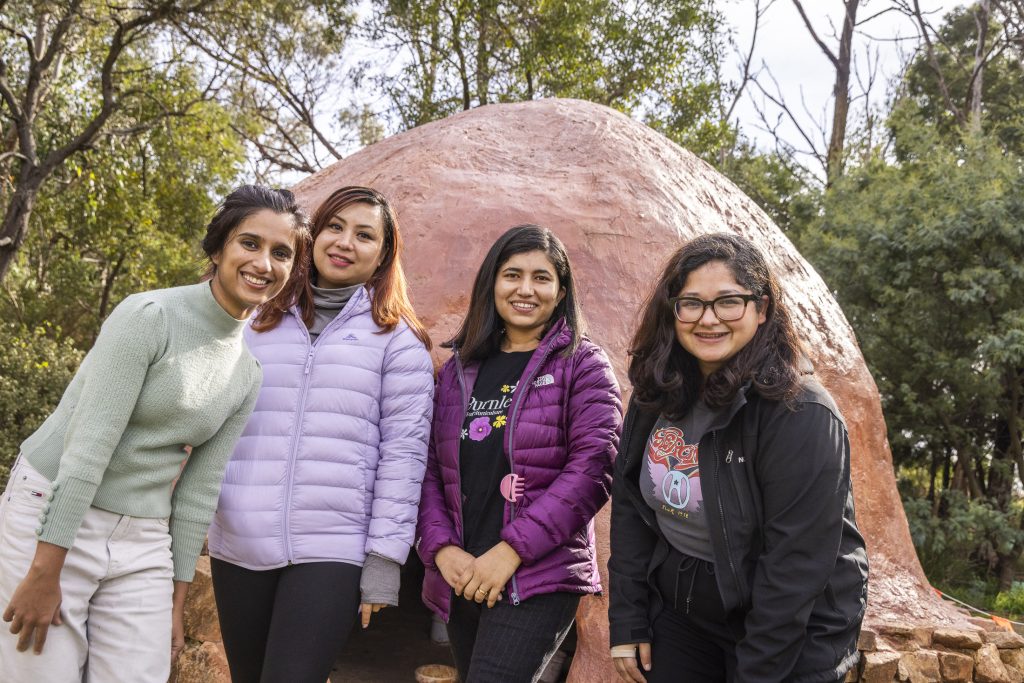
Sujita (right) pictured with other Nepali scholars during a visit to the Willum Warrain Aboriginal bush nursery in Hastings on the Mornington Peninsula in 2024 to learn about local First Nations people.
Perhaps most importantly, Sujita was thankful for the individually-tailored care that treated her as a person and not just a statistic. She gives an example of an incident when her physical and mental health were suffering: “I received a lot of support from [the] Australia Awards team and University of Melbourne. They directed me to the right services, and I was able to get the help I needed to continue my studies.”
Sujita’s Australia Awards Scholarship was not the only opportunity she benefited from. She was also fortunate enough to receive a Wattle Fellowship while in Australia. “It is a sustainability leadership program for students here at University of Melbourne,” she explains. The Fellowship empowers students to develop the capabilities needed to create lasting change in their communities and beyond. Over the course of a year, Wattle Fellows engage in learning activities such as retreats, workshops, events and mentoring. “It helped me in polishing my leadership skills and also to have a co-learning space with other peers from different faculties,” Sujita says. “This opportunity helped me to develop the networking skills and find friends for life that I will be collaborating [with] in future as well.”
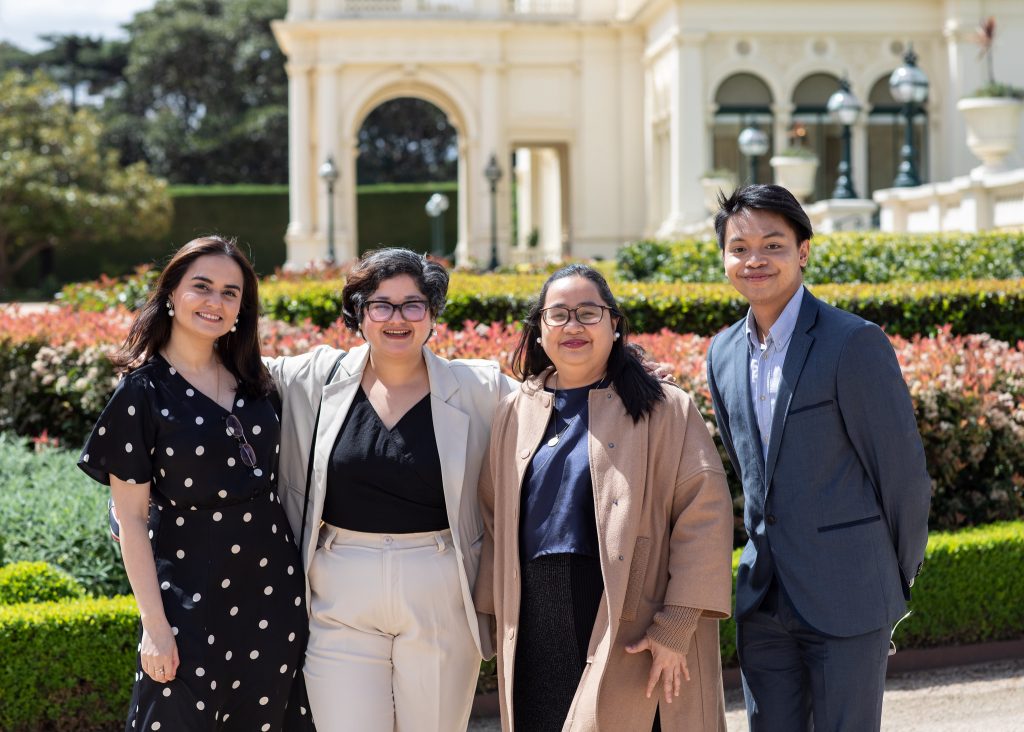
Sujita (second from left) photographed with other scholars during the Australia Awards 2024 End of Year event at Government House in Melbourne.
The Wattle Fellowship was Sujita’s main focus outside of studying, but she still had time for some extracurricular activities. “I’m testing new cuisines at different restaurants, exploring different natural beauties here or meeting friends from different parts of the world,” she said. “For me, meeting people from all around the world has been the most interesting part of living in Australia.” She mentions that she had friends in Australia who hailed from 12 different countries. “We exchange different cultures, different types of food and different kind of learnings.”
Another thing that she enjoyed was the natural beauty of Australia. “I saw sea for the first time here in Australia, and I was in tears,” she says, declaring that it was one of the most beautiful parts of her stay.
All in all, Sujita has only good things to say about her Australia Awards experience, and wants to see others from Nepal follow in her footsteps. “I highly encourage women and people from marginalised communities to apply for [an] Australia Awards Scholarship,” she says. “It was a great privilege for me. And now this privilege has become a purpose, so I can give back to the community I came from. So can a lot of women in Nepal.”
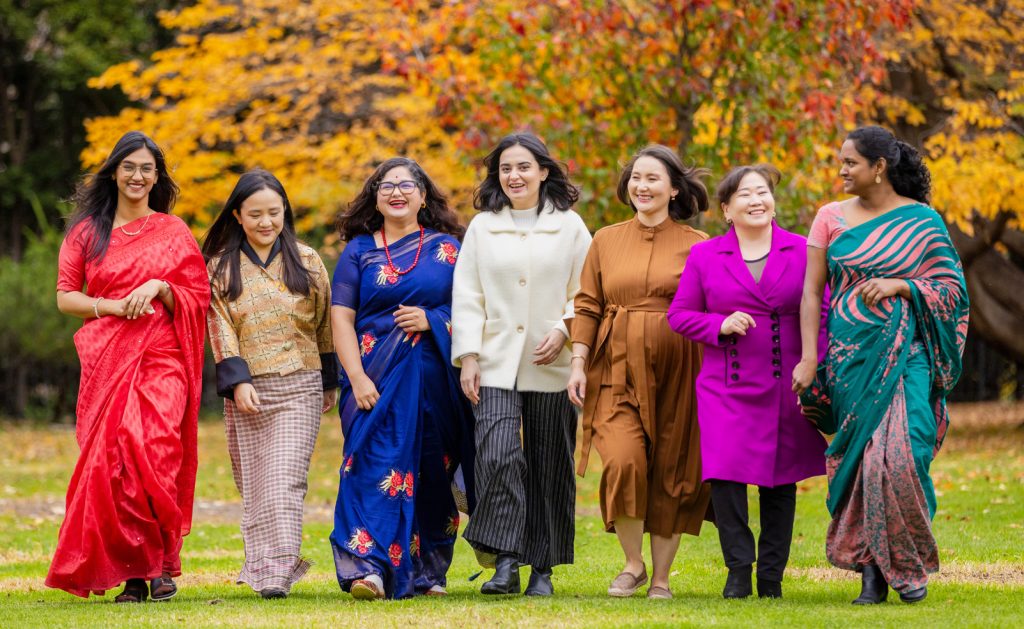
Sujita (third from left), with other Australia Awards scholars from South Asia and Mongolia in Melbourne.
This encouragement comes with specific suggestions. “For people who want to apply,” Sujita says, “my advice is to have an open mind. [An] Australia Awards Scholarship is not just about earning your degree. It’s about building your leadership and networking skills so that you can take that knowledge to apply [in your home country].”
Sujita says that her experience has been lifechanging: “[My] Australia Awards Scholarship has given me a platform to be myself and be a changemaker for gender equality,” she concludes.