

Alumni Forum explores Nepal’s path to flood resilience
Posted: 16 October 2026
On 2 October 2026, Australia Awards – Nepal and the Association of Nepalese Alumni from Australia (ANAA) held an online Alumni Forum on ‘The Nepal Floods 2026: Learning from crisis, building resilience, shaping recovery’.
The event, facilitated by ANAA General Secretary Manisha Burlakoti, brought together three dozen participants to hear from Australia Awards alum and climate change expert Dr Bimal Raj Regmi, who shared his insights in the wake of the devastating Rasuwa–Bhote Koshi flood that struck communities along the Bhote Koshi–Trisuli river corridor in central Nepal on 26 August. According to figures presented during the forum, more than 1,400 people lost their lives, around 6,000 are reported missing and thousands are injured, while damage to property and critical infrastructure is extensive.

Alum and ANAA Executive Member Manisha Burlakoti facilitating another Australia Awards – Nepal event.
Floods and climate-induced disasters have become increasingly frequent and severe across Nepal in recent years. Dr Regmi traced a pattern of major disasters from the 2021 Melamchi flood through the 2023 Kagbeni flood in Mustang, the Thame glacial lake outburst flood and extreme rainfall in the Kathmandu Valley in 2024, and glacial lake outburst floods in Humla and Rasuwa and intense rainfall in Ilam in 2025, to the Rasuwa–Bhote Koshi disaster in 2026. He noted that the latest disaster is conspicuous for the unprecedented scale of its human and physical devastation, accounting for more than 70% of the total deaths from the disasters that he mentioned. “This is not a change now; it is a crisis that we are facing,” Dr Regmi said, highlighting the increasing severity of climate extremes and their consequences.
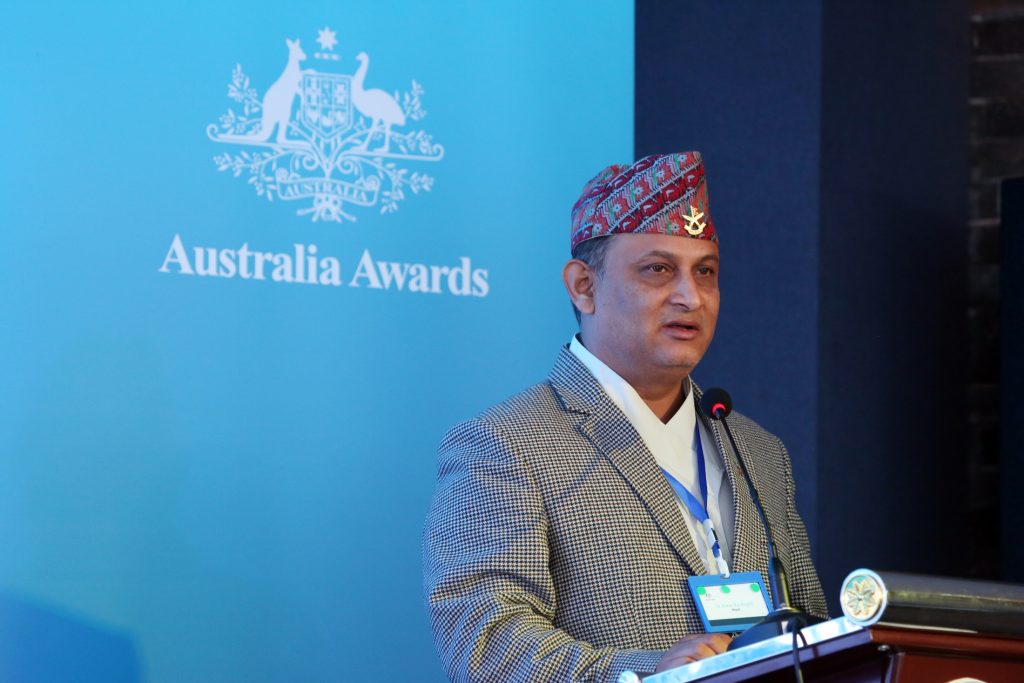
Alum Dr Bimal Raj Regmi presenting his work at the 2023 Regional Alumni Workshop in Ulaanbaatar, Mongolia, on the theme of ‘Buidling back better: Climate Resilience and Green Economic Recover.
Explaining the causes of the Rasuwa–Bhote Koshi flood, Dr Regmi described it as the result of interconnected and cascading hazards rather than a single event. A combined glacier, ice and bedrock failure triggered further effects downstream, including landslides and flash flooding. He highlighted several possible preconditioning factors, including warming-related permafrost degradation, ice fracture and thaw, heavier rainfall at higher elevations, glacier thinning, and increased meltwater infiltration. While acknowledging continuing scientific uncertainties, he said rising temperatures and changing precipitation patterns provided a strong climate signal and underscored the growing risks facing Nepal’s fragile mountain landscapes.
In addition to fatalities and injuries, the flood caused extensive damage to infrastructure, livelihoods and the wider economy. Hydropower facilities were particularly affected, with 13 projects (representing more than 700 megawatts of generation capacity) reported as severely damaged, alongside significant damage to transport infrastructure and settlements. Dr Regmi stressed, however, that the impacts extended well beyond what could be expressed in monetary terms. Displacement, loss of livelihoods and employment, damage to biodiversity and cultural heritage, disruption of communities, and psychological and other health impacts all constituted significant non-economic loss and damage. Vulnerable and marginalised households faced additional pressures, while the loss of homes, ancestral land and cultural connections risked leaving lasting social and psychological scars. Dr Regmi noted that these impacts are inadequately captured in existing loss and damage assessments, potentially understating the true scale of disasters such as the Rasuwa–Bhote Koshi flood.
The scale and breadth of these impacts also offer important lessons for Nepal’s approach to development and disaster risk reduction. Dr Regmi highlighted gaps in scientific research and cryosphere monitoring and surveillance, as well as Nepal’s limited understanding of the cascading and compounding effects of multiple hazards. He advocated moving beyond conventional early warning systems towards early information systems that provide governments, communities, investors and the private sector with risk information before development decisions and investments are made. He also emphasised integrated multi-hazard risk assessment and risk-informed land-use and infrastructure planning, particularly for hydropower and other major investments in fragile mountain and river corridors.
Looking ahead, Dr Regmi said the crisis also provides an opportunity to rethink development and build greater resilience. Priorities include strengthening Nepal’s scientific and institutional capacity, investing in research and human resources, improving satellite and ground-based monitoring, and enhancing cooperation with neighbouring countries for cross-border monitoring and early information. Given the transboundary nature of Himalayan climate risks, he stressed the importance of regional collaboration, particularly with India and China. He also highlighted the need for easier and more predictable access to international climate finance and advocated for trigger-based mobilisation of loss and damage funding so that resources can reach disaster-affected countries more quickly.
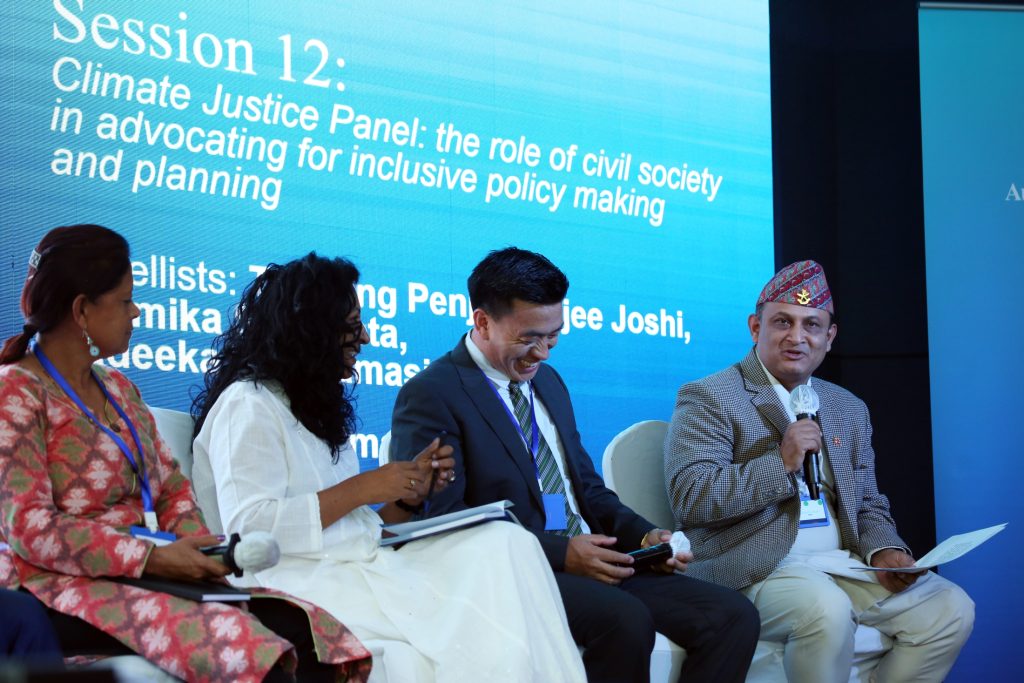
Dr Bimal Raj Regmi (right) moderating a panel discussion on climate justice at the 2023 Regional Alumni Workshop in Ulaanbaatar, Mongolia.
Recovery, he emphasised, must extend beyond rebuilding damaged physical infrastructure. Pointing to the need to restore livelihoods and market systems, regenerate jobs and employment, and address the “invisible scars” of non-economic loss and damage, Dr Regmi said, “recovery and resilience do not mean only physical construction”. He called for a longer-term and more integrated approach to recovery that supports displaced communities, addresses social and psychological impacts, and helps communities rebuild livelihoods while strengthening resilience to future disasters.
The presentation prompted a wide-ranging discussion among alumni and other participants. Questions and reflections focused on Nepal’s shortage of specialists and young researchers in cryosphere and mountain sciences; opportunities to strengthen research during the 2025–2034 Decade of Action for Cryospheric Sciences; the need to integrate climate resilience and multi-hazard risk information into infrastructure planning and design; and safer reconstruction and settlement planning.
Alumni also raised questions about whether Nepal needs to rethink development models that concentrate roads, hydropower projects and settlements along vulnerable river corridors, as well as about gaps in monitoring and warning systems, climate justice and compensation, and how Nepal can better prepare for hazards that science may not yet be able to predict with precision.
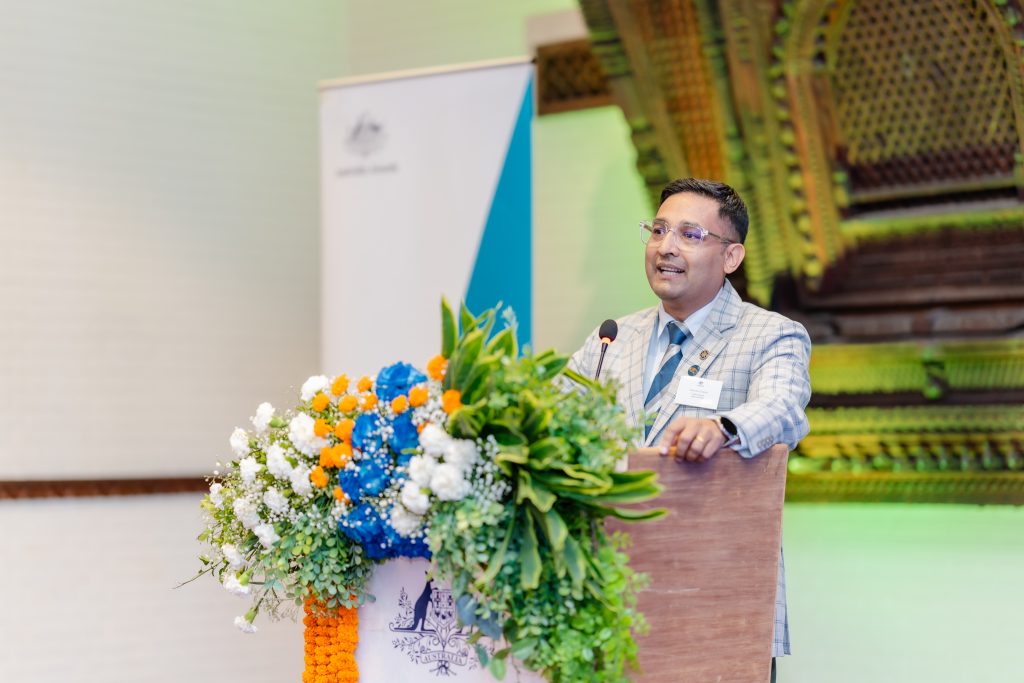
ANAA President Sudarshan Neupane speaking at a recent Australia Awards – Nepal event.
Concluding the forum, ANAA President Sudarshan Neupane thanked Dr Regmi and the participants for contributing their expertise, experiences and perspectives. He emphasised that the role of the alumni community extends beyond professional networking to sharing knowledge, experience, expertise and a collective voice on issues that matter to Nepal.
Australia Awards – Nepal’s Alumni Forum is a platform for alumni to share their expertise and insights and contribute to dialogue on issues of national importance.
Cover photo- Alum and climate change expert Dr Bimal Raj Regmi speaking at another Australia Awards – Nepal event.